
Standardization Enables Broad Cooperation in Vehicle Development

software

Standardization Enables Broad Cooperation in Vehicle Development

Standardization Enables Broad Cooperation in Vehicle Development

Automotive development has emerged from its hardware-centric past. Today it is software that defines the most differentiating vehicle features, including driver assistance, infotainment, connectivity and automated driving.

Just like many different suppliers contribute physical components to a single vehicle, it will take many partners and suppliers to create the complex software needed to run vehicles in the future.

Common standards will play an important role in achieving that level of collaboration. When properly implemented, standards allow different teams and companies to more easily integrate software into the overall code base and perform automated testing. Standards speed up development, reduce errors and enable timely updates before and after production begins.

MULTIPLE LEVELS

Standardization is occurring at several levels, including APIs, software components, overall frameworks and software development practices. Standard APIs APIs are software interfaces that allow different applications to talk to each other. Establishing standard APIs allows developers to create, test and update each application or function independently and enables them to integrate that code into larger applications.

Importantly, APIs also support the development of new vehicle architectures, allowing software for multiple functions to run side by side on a powerful central domain controller or open server platform rather than on smaller electronic control units (ECUs). This makes both hardware and software more scalable and flexible while reducing complexity, manufacturing costs and power consumption.

Any shared API — whether proprietary, open or industry standard — allows the code developed by each party to remain closely protected while enabling it to be integrated faster with other components through the API, using continuous integration and continuous deployment (CI/ CD). The terms of use can be defined in code so that specific contracts are not required to make applications interoperate.

The more widely available APIs are, the larger the potential ecosystem of interoperable software. APIs created or owned by individual OEMs and suppliers may become de facto standards. However, industry-standard APIs, which may be jointly developed and adopted by competing companies, provide interfaces and supporting resources that can be widely adopted and updated outside of vendor relationships. This facilitates collaboration and integration among all players. The Java Community Project provides a model for this process from the IT industry: Under the JCP, each standard has an open API definition, a reference implementation of the standard, and a client to check the correctness of each company’s implementation.


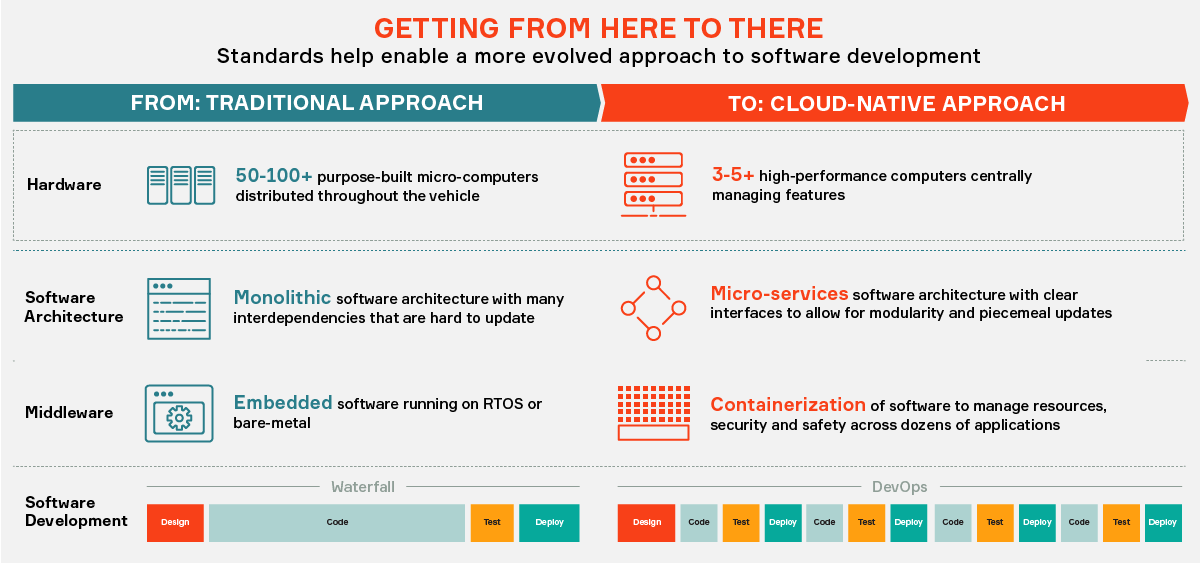
GETTING FROM HERE TO THERE
Standards help enable a more evolved approach to software development.

Graphic 1


Standard components

Standard APIs facilitate the standardization of interoperable software components for use in multiple applications and vehicle platforms. Having these components available can eliminate the time and effort involved in developing code for basic functions within an application that might not differentiate a vehicle, such as low-level networking operations.

Development using CI/CD and continuous testing allows OEMs and suppliers to reuse non-differentiating code without going through time-consuming traditional integration and validation processes. They can share common software components across multiple vehicle platforms and applications from different suppliers. They can also improve quality by substituting proven components for code developed from scratch for each new feature.

Standardization initiatives Cooperative efforts across the auto industry are helping to facilitate standardization for software-defined vehicle development. With software functions distributed across various ECUs networked within a vehicle, it is becoming imperative to put in place standardized interfaces to establish communication between vehicle software components and the cloud. The eSync Alliance, whose membership includes a global network of cooperating companies, seeks to standardize over-the-air (OTA) updating and data gathering for the connected car. The alliance developed a spec, available to all members, that is based on a server-client-agent model for a secure, bidirectional data path between the cloud and electronic devices inside a vehicle. The ultimate aim of the eSync Alliance is to establish a standardized OTA process that is agnostic of hardware platform, operating system, cloud, communication network and in-vehicle architecture.

GROUPS WORKING TOWARD STANDARDS

As automotive software development expands rapidly, various groups are tackling the need for standards:

  • Automotive Open System Architecture (AUTOSAR): Promoting a middleware-based approach to facilitate distributed development
  • Connected Vehicle Systems Alliance (COVESA): Working with W3C on the Common Vehicle Interface Initiative to develop common standards for automotive data models and APIs
  • Eclipse Software Defined Vehicle Working Group: Building and promoting open source software, specifications, and open collaboration models
  • eSync Alliance: Standardizing over-the-air (OTA) updating and data gathering for connected cars
  • Scalable Open Architecture for Embedded Edge (SOAFFEE): Developing a cloud-native architecture for mixed-criticality automotive applications
  • Trusted Information Security Exchange (TISAX): Providing a standard way to ensure security for hardware and software

Automotive Open System Architecture (AUTOSAR), a partnership that includes most major OEMs and suppliers, is promoting a middleware-based approach to facilitate distributed development. AUTOSAR’s standard software frameworks enable the reuse and exchange of software across vehicle platforms, applications and supplier solutions. They are designed for linking basic system software to applications through middleware — instead of using tight integration unique to each vehicle platform — to reduce cost and development time and ensure quality and safety.

Another standards effort around software-defined vehicles is the Common Vehicle Interface Initiative (CVII) between the Connected Vehicle Systems Alliance (COVESA) industry consortium and the W3C. Aptiv is an active member of COVESA, which describes itself as “the only alliance focused solely on developing open standards and technologies for connected vehicles.” The aim of CVII is to develop common standards for automotive data models and APIs, partly to enable the use of interoperable software components and streamline integration. CVII may help support the consolidation of applications in central ECUs, but its scope extends to standards for services outside the vehicle that may leverage cloud computing, roadside infrastructure and vehicle-to-everything wireless communication.

ASPICE, or Automotive Software Performance Improvement and Capability Determination, is a standard for automotive software best practices that some organizations have adopted as a standard model. Based on SPICE, or ISO/IEC 15504, ASPICE is designed to help suppliers eliminate potential problems early in development and provide quality assurance to clients. It does not dictate specific tools or techniques but is used to evaluate each supplier’s approach to its own selected development models.

PROGRESS TOWARD STANDARDIZATION

Many OEMs now recognize the value of standardization for software interoperability, continuous integration, accelerated development and code quality. However, the industry has hurdles to overcome to fully realize its benefits.

In some cases, regulations may make it more complex for OEMs, Tier 1s and other suppliers to pursue joint standards-based development. For example, the German Automotive Industry Association requires an information security assessment of any company involved in the German automotive supply chain, under the Trusted Information Security Exchange (TISAX) standard. While TISAX itself provides a standard way to ensure that all hardware and software are as secure as possible, a strict requirement for ongoing compliance may slow or prevent contributions from potential development partners. In some cases, companies also need to use caution in technical cooperation as antitrust regulators closely scrutinize these activities.

Collaborative development using CI/CD requires more than common standards and a will to embrace new methods. Established ways of doing business also need to change (see related white paper, “What the Next Phase of Automotive Software Development Looks Like”). The current relationships among OEMs, Tier 1s and other suppliers are designed for buying and selling hardware. A commercial arrangement governed by standard APIs rather than contracts that enables a supplier to make continuous software contributions to an OEM requires different business practices that are only beginning to take shape. With such arrangements in place, developers across different organizations will be able to collaborate by using cloud-native platforms for full lifecycle management.

Aptiv is at the forefront of software-defined vehicle development to empower OEMs to control the software that defines their vehicles through the use of standard APIs, software components and frameworks. And we are actively working with COVESA and the eSync Alliance to drive standards in those APIs. Our leadership in this area allows us to form effective partnerships with OEMs that are seeking the benefits of standards-based practices.


-----------------------------------

Automotive development has emerged from its hardware-centric past. Today it is software that defines the most differentiating vehicle features, including driver assistance, infotainment, connectivity and automated driving. Just like many different suppliers contribute physical components to a single vehicle, it will take many partners and suppliers to create the complex software needed to run vehicles in the future.

Common standards will play an important role in achieving that level of collaboration. When properly implemented, standards allow different teams and companies to more easily integrate software into the overall code base and perform automated testing. Standards speed up development, reduce errors and enable timely updates before and after production begins.

Many OEMs now recognize the value of standardization for software interoperability, continuous integration, accelerated development and code quality. However, the industry has hurdles to overcome to fully realize its benefits.

Standardization is occurring at several levels, including APIs, software components, overall frameworks and software development practices. For a deep dive into each of these areas, read our white paper.
Read White Paper

Automotive development has emerged from its hardware-centric past. Today it is software that defines the most differentiating vehicle features, including driver assistance, infotainment, connectivity and automated driving.

Just like many different suppliers contribute physical components to a single vehicle, it will take many partners and suppliers to create the complex software needed to run vehicles in the future.

Common standards will play an important role in achieving that level of collaboration. When properly implemented, standards allow different teams and companies to more easily integrate software into the overall code base and perform automated testing. Standards speed up development, reduce errors and enable timely updates before and after production begins.

MULTIPLE LEVELS

Standardization is occurring at several levels, including APIs, software components, overall frameworks and software development practices. Standard APIs APIs are software interfaces that allow different applications to talk to each other. Establishing standard APIs allows developers to create, test and update each application or function independently and enables them to integrate that code into larger applications.

Importantly, APIs also support the development of new vehicle architectures, allowing software for multiple functions to run side by side on a powerful central domain controller or open server platform rather than on smaller electronic control units (ECUs). This makes both hardware and software more scalable and flexible while reducing complexity, manufacturing costs and power consumption.

Any shared API — whether proprietary, open or industry standard — allows the code developed by each party to remain closely protected while enabling it to be integrated faster with other components through the API, using continuous integration and continuous deployment (CI/ CD). The terms of use can be defined in code so that specific contracts are not required to make applications interoperate.

The more widely available APIs are, the larger the potential ecosystem of interoperable software. APIs created or owned by individual OEMs and suppliers may become de facto standards. However, industry-standard APIs, which may be jointly developed and adopted by competing companies, provide interfaces and supporting resources that can be widely adopted and updated outside of vendor relationships. This facilitates collaboration and integration among all players. The Java Community Project provides a model for this process from the IT industry: Under the JCP, each standard has an open API definition, a reference implementation of the standard, and a client to check the correctness of each company’s implementation.


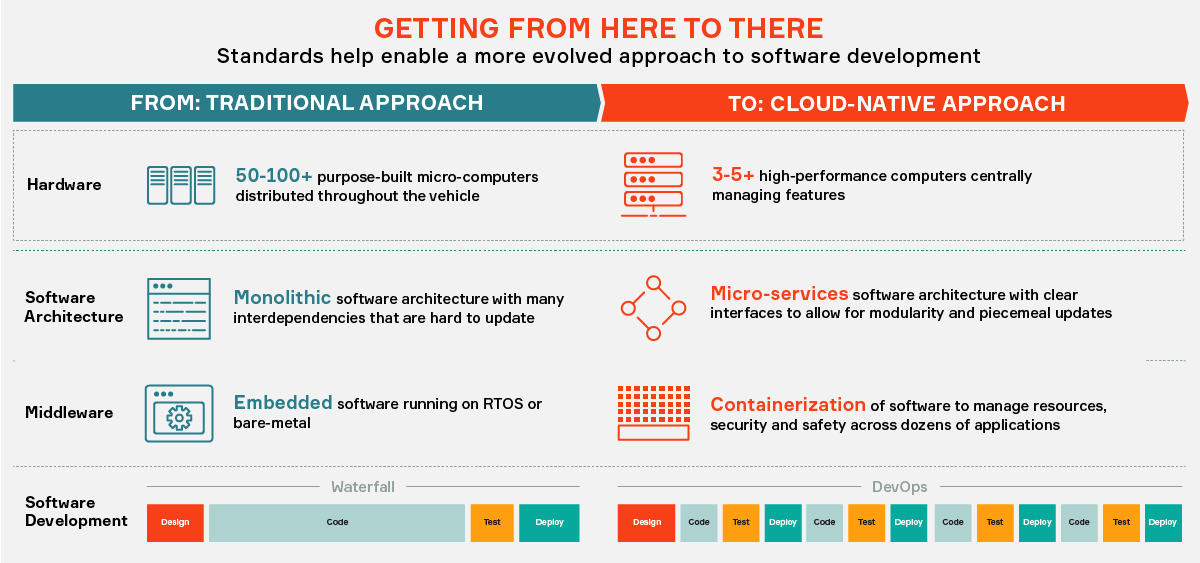
GETTING FROM HERE TO THERE
Standards help enable a more evolved approach to software development.

Graphic 1


Standard components

Standard APIs facilitate the standardization of interoperable software components for use in multiple applications and vehicle platforms. Having these components available can eliminate the time and effort involved in developing code for basic functions within an application that might not differentiate a vehicle, such as low-level networking operations.

Development using CI/CD and continuous testing allows OEMs and suppliers to reuse non-differentiating code without going through time-consuming traditional integration and validation processes. They can share common software components across multiple vehicle platforms and applications from different suppliers. They can also improve quality by substituting proven components for code developed from scratch for each new feature.

Standardization initiatives Cooperative efforts across the auto industry are helping to facilitate standardization for software-defined vehicle development. With software functions distributed across various ECUs networked within a vehicle, it is becoming imperative to put in place standardized interfaces to establish communication between vehicle software components and the cloud. The eSync Alliance, whose membership includes a global network of cooperating companies, seeks to standardize over-the-air (OTA) updating and data gathering for the connected car. The alliance developed a spec, available to all members, that is based on a server-client-agent model for a secure, bidirectional data path between the cloud and electronic devices inside a vehicle. The ultimate aim of the eSync Alliance is to establish a standardized OTA process that is agnostic of hardware platform, operating system, cloud, communication network and in-vehicle architecture.

GROUPS WORKING TOWARD STANDARDS

As automotive software development expands rapidly, various groups are tackling the need for standards:

  • Automotive Open System Architecture (AUTOSAR): Promoting a middleware-based approach to facilitate distributed development
  • Connected Vehicle Systems Alliance (COVESA): Working with W3C on the Common Vehicle Interface Initiative to develop common standards for automotive data models and APIs
  • Eclipse Software Defined Vehicle Working Group: Building and promoting open source software, specifications, and open collaboration models
  • eSync Alliance: Standardizing over-the-air (OTA) updating and data gathering for connected cars
  • Scalable Open Architecture for Embedded Edge (SOAFFEE): Developing a cloud-native architecture for mixed-criticality automotive applications
  • Trusted Information Security Exchange (TISAX): Providing a standard way to ensure security for hardware and software

Automotive Open System Architecture (AUTOSAR), a partnership that includes most major OEMs and suppliers, is promoting a middleware-based approach to facilitate distributed development. AUTOSAR’s standard software frameworks enable the reuse and exchange of software across vehicle platforms, applications and supplier solutions. They are designed for linking basic system software to applications through middleware — instead of using tight integration unique to each vehicle platform — to reduce cost and development time and ensure quality and safety.

Another standards effort around software-defined vehicles is the Common Vehicle Interface Initiative (CVII) between the Connected Vehicle Systems Alliance (COVESA) industry consortium and the W3C. Aptiv is an active member of COVESA, which describes itself as “the only alliance focused solely on developing open standards and technologies for connected vehicles.” The aim of CVII is to develop common standards for automotive data models and APIs, partly to enable the use of interoperable software components and streamline integration. CVII may help support the consolidation of applications in central ECUs, but its scope extends to standards for services outside the vehicle that may leverage cloud computing, roadside infrastructure and vehicle-to-everything wireless communication.

ASPICE, or Automotive Software Performance Improvement and Capability Determination, is a standard for automotive software best practices that some organizations have adopted as a standard model. Based on SPICE, or ISO/IEC 15504, ASPICE is designed to help suppliers eliminate potential problems early in development and provide quality assurance to clients. It does not dictate specific tools or techniques but is used to evaluate each supplier’s approach to its own selected development models.

PROGRESS TOWARD STANDARDIZATION

Many OEMs now recognize the value of standardization for software interoperability, continuous integration, accelerated development and code quality. However, the industry has hurdles to overcome to fully realize its benefits.

In some cases, regulations may make it more complex for OEMs, Tier 1s and other suppliers to pursue joint standards-based development. For example, the German Automotive Industry Association requires an information security assessment of any company involved in the German automotive supply chain, under the Trusted Information Security Exchange (TISAX) standard. While TISAX itself provides a standard way to ensure that all hardware and software are as secure as possible, a strict requirement for ongoing compliance may slow or prevent contributions from potential development partners. In some cases, companies also need to use caution in technical cooperation as antitrust regulators closely scrutinize these activities.

Collaborative development using CI/CD requires more than common standards and a will to embrace new methods. Established ways of doing business also need to change (see related white paper, “What the Next Phase of Automotive Software Development Looks Like”). The current relationships among OEMs, Tier 1s and other suppliers are designed for buying and selling hardware. A commercial arrangement governed by standard APIs rather than contracts that enables a supplier to make continuous software contributions to an OEM requires different business practices that are only beginning to take shape. With such arrangements in place, developers across different organizations will be able to collaborate by using cloud-native platforms for full lifecycle management.

Aptiv is at the forefront of software-defined vehicle development to empower OEMs to control the software that defines their vehicles through the use of standard APIs, software components and frameworks. And we are actively working with COVESA and the eSync Alliance to drive standards in those APIs. Our leadership in this area allows us to form effective partnerships with OEMs that are seeking the benefits of standards-based practices.


-----------------------------------

Automotive development has emerged from its hardware-centric past. Today it is software that defines the most differentiating vehicle features, including driver assistance, infotainment, connectivity and automated driving. Just like many different suppliers contribute physical components to a single vehicle, it will take many partners and suppliers to create the complex software needed to run vehicles in the future.

Common standards will play an important role in achieving that level of collaboration. When properly implemented, standards allow different teams and companies to more easily integrate software into the overall code base and perform automated testing. Standards speed up development, reduce errors and enable timely updates before and after production begins.

Many OEMs now recognize the value of standardization for software interoperability, continuous integration, accelerated development and code quality. However, the industry has hurdles to overcome to fully realize its benefits.

Standardization is occurring at several levels, including APIs, software components, overall frameworks and software development practices. For a deep dive into each of these areas, read our white paper.
Read White Paper

How helpful was this article?
i


×

Please let us know how helpful this article was, so we can provide you with the best content possible. If you have more feedback to share, please feel free to contact us.
Thank you!

Careers


Shape the future of mobility. Join our team to help create vehicles that are safer, greener and more connected.

View Related Jobs
All Attachments (2)