
Designing Large-Scale Software for Reuse With an Automotive Company

Designing Large-Scale Software for Reuse With an Automotive Company

Designing Large-Scale Software for Reuse With an Automotive Company

A leading European commercial vehicle manufacturer had to upgrade its infotainment system to support continuous AndroidTM version updates and feature improvements — and make the software extensible across product lines. Aptiv’s solution will enable the OEM’s engineers to reuse three-quarters of the technology components across upcoming platforms.

The Agile development methodology’s emphasis on short coding sprints, iterative development and code reuse applies to projects of any size. Aptiv’s recent experience with a European commercial vehicle manufacturer exemplifies the successful application of Agile practices across multiple companies.

Looming changes


Upcoming legislation will require commercial trucks to comply with new visibility, cybersecurity and functional safety guidelines. For instance, when a truck slows down, that intention must be signaled to other road users via flashing brake lights. The urgency to prepare for compliance meant that the commercial vehicle manufacturer needed to make architectural and user interface (UI) changes to its vehicles’ Android-based infotainment systems. The UI adjustments affect a wide range of features, including brake lights, driver attentiveness monitoring and the vehicle data displayed to truck drivers — all on a resized physical dashboard. The overarching goal was to enhance cabin interior design to meet the latest safety standards.

There were several challenges. First, the manufacturer’s product line encompasses several Android versions across multiple geographies. Its Android-based systems need to take advantage of new operating system features without dropping support for existing users across legacy versions or yet-to-be-released versions.

Second, lifecycle management had to be a critical part of the design. With so many truck configurations to support, the software architecture had to stay simple and be flexible enough for regular updates.

Third, the base software layer had to integrate with several other systems. To support a unique, brand-conscious user experience, the cockpit system integrates several solutions, such as Aptiv® software, the OEM’s proprietary software and third-party vendor software. Moreover, the manufacturer wanted to use its own cluster software in the integrated cockpit system, which is Linux-based.

Aptiv’s approach

Aptiv developed a system that enabled the OEM to meet its goals for legislation compliance, functionality, flexibility, integration and cost savings. In 2023, the combined development teams began by consolidating features and integrating code modules into a single electronic control unit that would address the physical constraints of a smaller dashboard.

Collaboration

Most successful Agile projects start with humans collaborating, and this one was no exception.

By its nature, automotive technology requires long-term planning. The teams met to set objectives, requirements and priorities. The engineers discussed expectations, and, in one-on-one sessions, they contemplated how to design easy-to-reuse Android building blocks. Working transparently, the teams collaborated on the development plan, adjusted as needed and shared the feature backlog. That translated into real-world productivity — and also reduced both the introduction cost and long-term maintenance costs.

Reuse

Aptiv’s previous work with the commercial vehicle manufacturer on an infotainment unit had established a familiarity that served as a good starting point.

The Aptiv engineers focused on designing for reuse so that future developers would not have to start from scratch. The Aptiv team — or the OEM — can begin building new truck-related features for the Android-based infotainment project confident that the existing system is compatible with the OEM’s new applications. Aptiv’s reuse was most extensive in the infotainment core functions, such as the Android framework, touching on audio features and the driver interface.

For example, Aptiv provided a platform for the company to integrate its Linux-based cluster software, vehicle functions and Android-based fleet management apps. Aptiv emphasizes an SoC-agnostic approach, which means it can use a board support package from another vendor, develop the base software and deploy it on the OEM’s hardware. The manufacturer is responsible for Linux applications, and Aptiv supports the Android base software across all versions.

A hypervisor separates the domains. The Android operating system runs in its own Linux domain and exchanges data with the instrument cluster software. The system independence means that the team could reuse features as developers add functionality, ensuring that the OEM can exercise control over its own software. It also improves code quality. The design permits the OEM’s applications into the Aptiv base software, which improves confidence that upgrading to a new Android version will occur seamlessly. Plus, the system design benefits portability: Because the clusters are isolated through the hypervisor, the OEM could reuse functionality on new cluster types.

External updates

Lifecycle management support is a key issue. As the commercial vehicle manufacturer improves its software, it deploys apps as part of its service offering to fleet users. For example, the new version enables independent software updates. The OEM can update the infotainment system or the driver interface independently over the air. It can push out portions of the system, rather than a single large block of code, as needed. And the continuous integration and continuous delivery workflow, as found in the Wind River® Studio Developer platform, was also helpful.

With an open-platform approach, the commercial vehicle manufacturer can continue to work with third-party suppliers and additional technology platforms.

The results

The development plan has been successful, and the project is entering its next phase. The OEM and Aptiv are aligned on the process for developing and delivering the Android infotainment system. That delivery process enables more frequent software updates, allowing the OEM to provide more functionality to drivers, and it also offers reassurance that cybersecurity vulnerabilities will be fixed. 

And the new solution may save the company money. Integrating compute nodes from the cluster and infotainment sides into a single compute system offered cost advantages, though the project was not primarily motivated by financial considerations.

The current generation established a solid baseline. Aptiv can reuse about 75 percent of the platform, specifically Android and audio technology components, for future infotainment-related programs. This strategic reuse can accelerate development cycles, reduce engineering overhead, and significantly improve time to market. In essence, these investments lay the foundation for scalable efficiencies and faster delivery in tomorrow’s programs.

Challenge
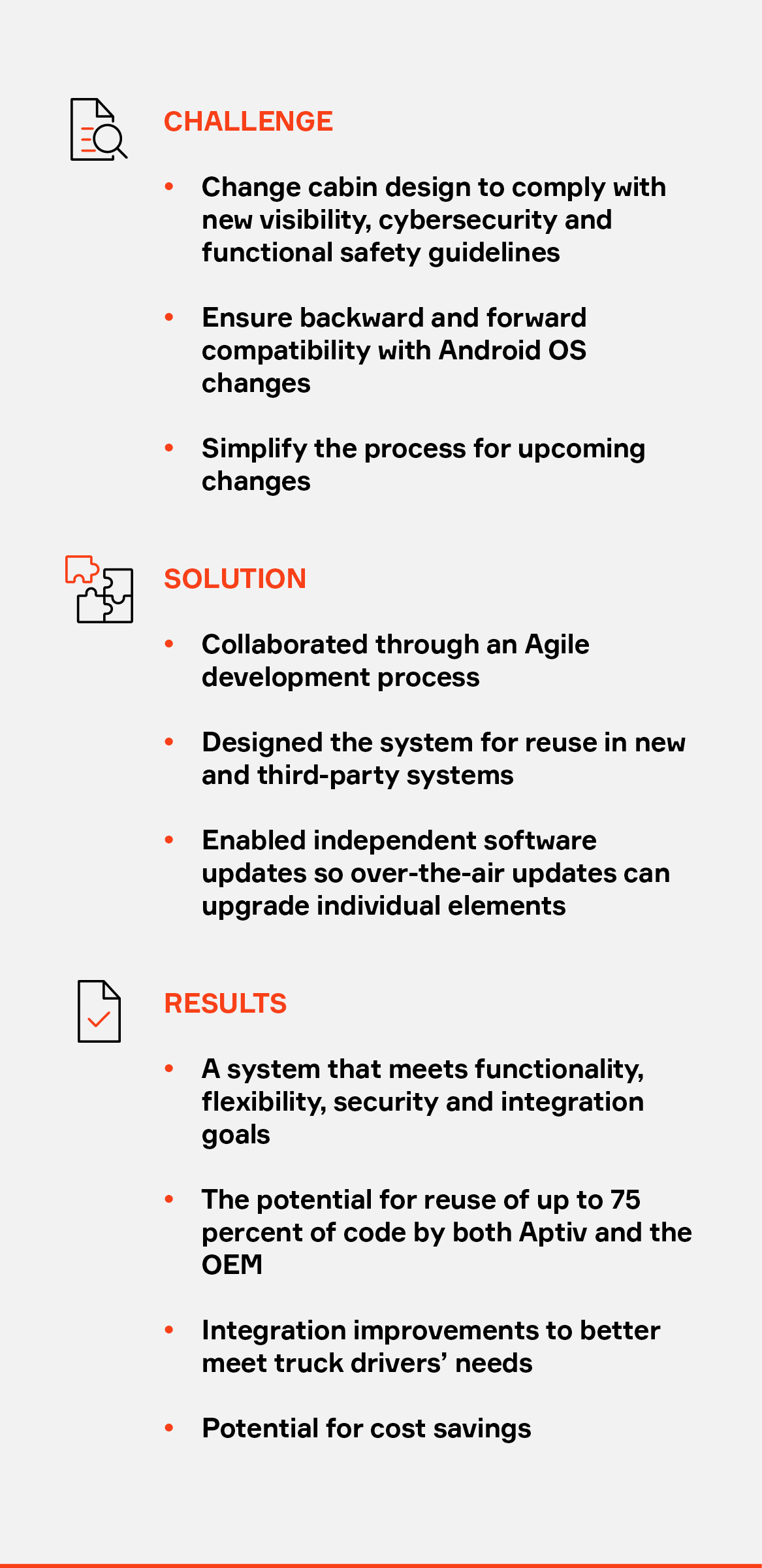
  • Change cabin design to comply with new visibility, cybersecurity and functional safety guidelines
  • Ensure backward and forward compatibility with Android OS changes
  • Simplify the process for upcoming changes
Solution
  • Collaborated through an Agile development process
  • Designed the system for reuse in new and third-party systems
  • Enabled independent software updates so over-the-air updates can upgrade individual elements
Results
  • A system that meets functionality, flexibility, security and integration goals
  • The potential for reuse of up to 75 percent of code by both Aptiv and the OEM
  • Integration improvements to better meet truck drivers’ needs
  • Potential for cost savings

Android is a trademark of Google LLC.
A leading European commercial vehicle manufacturer had to upgrade its infotainment system to support continuous AndroidTM version updates and feature improvements — and make the software extensible across product lines. Aptiv’s solution will enable the OEM’s engineers to reuse three-quarters of the technology components across upcoming platforms.

The Agile development methodology’s emphasis on short coding sprints, iterative development and code reuse applies to projects of any size. Aptiv’s recent experience with a European commercial vehicle manufacturer exemplifies the successful application of Agile practices across multiple companies.

Looming changes


Upcoming legislation will require commercial trucks to comply with new visibility, cybersecurity and functional safety guidelines. For instance, when a truck slows down, that intention must be signaled to other road users via flashing brake lights. The urgency to prepare for compliance meant that the commercial vehicle manufacturer needed to make architectural and user interface (UI) changes to its vehicles’ Android-based infotainment systems. The UI adjustments affect a wide range of features, including brake lights, driver attentiveness monitoring and the vehicle data displayed to truck drivers — all on a resized physical dashboard. The overarching goal was to enhance cabin interior design to meet the latest safety standards.

There were several challenges. First, the manufacturer’s product line encompasses several Android versions across multiple geographies. Its Android-based systems need to take advantage of new operating system features without dropping support for existing users across legacy versions or yet-to-be-released versions.

Second, lifecycle management had to be a critical part of the design. With so many truck configurations to support, the software architecture had to stay simple and be flexible enough for regular updates.

Third, the base software layer had to integrate with several other systems. To support a unique, brand-conscious user experience, the cockpit system integrates several solutions, such as Aptiv® software, the OEM’s proprietary software and third-party vendor software. Moreover, the manufacturer wanted to use its own cluster software in the integrated cockpit system, which is Linux-based.

Aptiv’s approach

Aptiv developed a system that enabled the OEM to meet its goals for legislation compliance, functionality, flexibility, integration and cost savings. In 2023, the combined development teams began by consolidating features and integrating code modules into a single electronic control unit that would address the physical constraints of a smaller dashboard.

Collaboration

Most successful Agile projects start with humans collaborating, and this one was no exception.

By its nature, automotive technology requires long-term planning. The teams met to set objectives, requirements and priorities. The engineers discussed expectations, and, in one-on-one sessions, they contemplated how to design easy-to-reuse Android building blocks. Working transparently, the teams collaborated on the development plan, adjusted as needed and shared the feature backlog. That translated into real-world productivity — and also reduced both the introduction cost and long-term maintenance costs.

Reuse

Aptiv’s previous work with the commercial vehicle manufacturer on an infotainment unit had established a familiarity that served as a good starting point.

The Aptiv engineers focused on designing for reuse so that future developers would not have to start from scratch. The Aptiv team — or the OEM — can begin building new truck-related features for the Android-based infotainment project confident that the existing system is compatible with the OEM’s new applications. Aptiv’s reuse was most extensive in the infotainment core functions, such as the Android framework, touching on audio features and the driver interface.

For example, Aptiv provided a platform for the company to integrate its Linux-based cluster software, vehicle functions and Android-based fleet management apps. Aptiv emphasizes an SoC-agnostic approach, which means it can use a board support package from another vendor, develop the base software and deploy it on the OEM’s hardware. The manufacturer is responsible for Linux applications, and Aptiv supports the Android base software across all versions.

A hypervisor separates the domains. The Android operating system runs in its own Linux domain and exchanges data with the instrument cluster software. The system independence means that the team could reuse features as developers add functionality, ensuring that the OEM can exercise control over its own software. It also improves code quality. The design permits the OEM’s applications into the Aptiv base software, which improves confidence that upgrading to a new Android version will occur seamlessly. Plus, the system design benefits portability: Because the clusters are isolated through the hypervisor, the OEM could reuse functionality on new cluster types.

External updates

Lifecycle management support is a key issue. As the commercial vehicle manufacturer improves its software, it deploys apps as part of its service offering to fleet users. For example, the new version enables independent software updates. The OEM can update the infotainment system or the driver interface independently over the air. It can push out portions of the system, rather than a single large block of code, as needed. And the continuous integration and continuous delivery workflow, as found in the Wind River® Studio Developer platform, was also helpful.

With an open-platform approach, the commercial vehicle manufacturer can continue to work with third-party suppliers and additional technology platforms.

The results

The development plan has been successful, and the project is entering its next phase. The OEM and Aptiv are aligned on the process for developing and delivering the Android infotainment system. That delivery process enables more frequent software updates, allowing the OEM to provide more functionality to drivers, and it also offers reassurance that cybersecurity vulnerabilities will be fixed. 

And the new solution may save the company money. Integrating compute nodes from the cluster and infotainment sides into a single compute system offered cost advantages, though the project was not primarily motivated by financial considerations.

The current generation established a solid baseline. Aptiv can reuse about 75 percent of the platform, specifically Android and audio technology components, for future infotainment-related programs. This strategic reuse can accelerate development cycles, reduce engineering overhead, and significantly improve time to market. In essence, these investments lay the foundation for scalable efficiencies and faster delivery in tomorrow’s programs.

Challenge
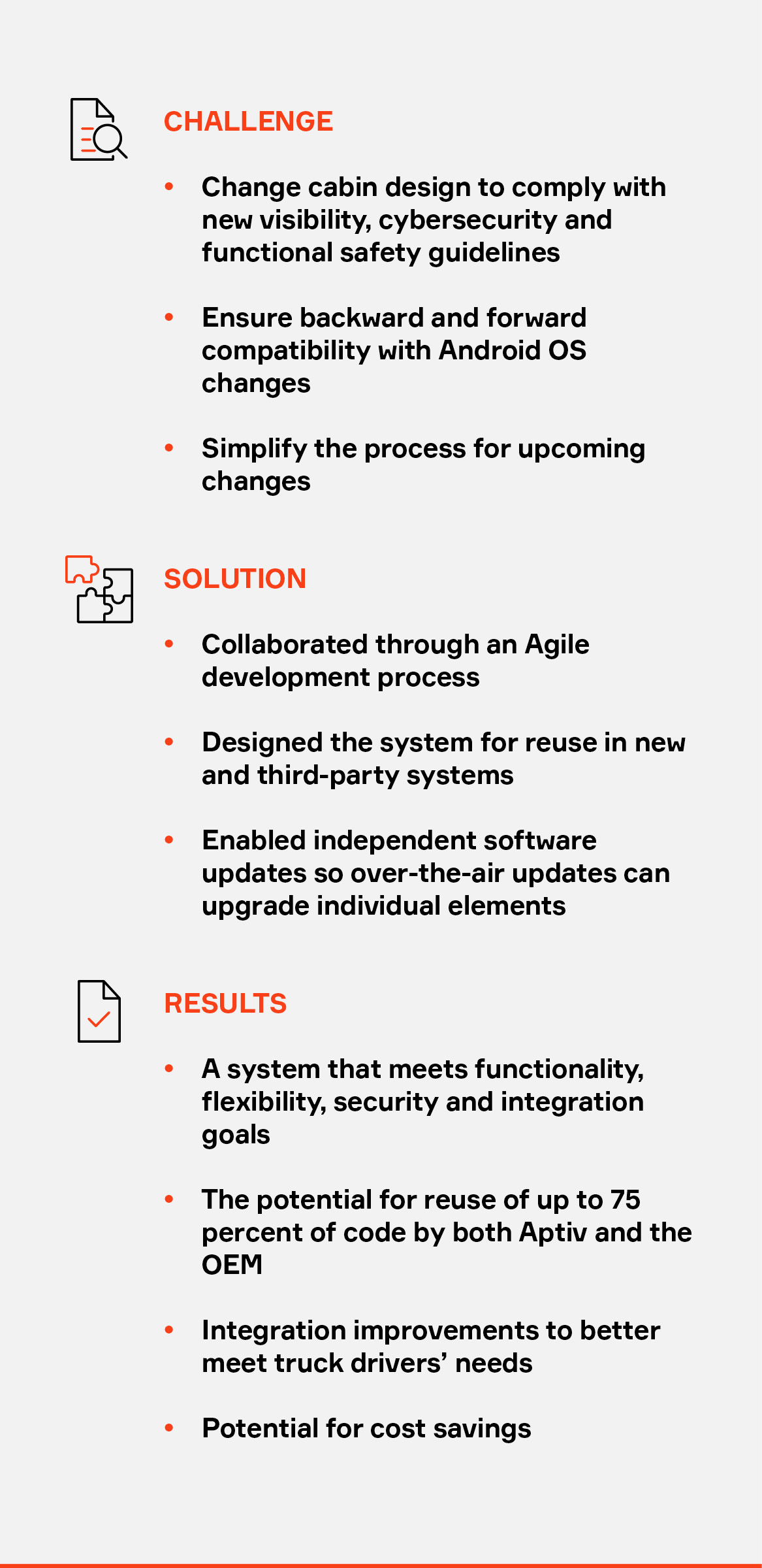
  • Change cabin design to comply with new visibility, cybersecurity and functional safety guidelines
  • Ensure backward and forward compatibility with Android OS changes
  • Simplify the process for upcoming changes
Solution
  • Collaborated through an Agile development process
  • Designed the system for reuse in new and third-party systems
  • Enabled independent software updates so over-the-air updates can upgrade individual elements
Results
  • A system that meets functionality, flexibility, security and integration goals
  • The potential for reuse of up to 75 percent of code by both Aptiv and the OEM
  • Integration improvements to better meet truck drivers’ needs
  • Potential for cost savings

Android is a trademark of Google LLC.
How helpful was this article?
i


×

Please let us know how helpful this article was, so we can provide you with the best content possible. If you have more feedback to share, please feel free to contact us.
Thank you!

Careers


Shape the future of mobility. Join our team to help create vehicles that are safer, greener and more connected.

View Related Jobs
All Attachments (1)