Global Powertrain Manufacturer Accelerates Modern Software Architecture with Aptiv LINC™
As software-defined vehicles rapidly evolve, OEMs are looking to bring legacy software into modern architectures without degrading its performance or the critical functionality that the software provides. A prominent powertrain manufacturer recently had to meet such a challenge.
The manufacturer’s systems had been built around microcontroller-based architectures using AUTOSAR Classic to handle core vehicle tasks such as engine control and after-treatment functions. Such systems take inputs from many sensors — measuring factors such as fuel rate, oxygen levels, engine behavior and driver input — to continuously determine how the engine should respond. For peak performance, the systems need reliable, well-coordinated deterministic software.
The existing systems were functioning well, but, like other OEMs, the manufacturer was looking to integrate distributed control functions onto centralized computing platforms based on a modern real-time operating system (RTOS). An RTOS can support greater flexibility, improve scalability across vehicle trim levels and reduce integration complexity across a vehicle.
The manufacturer had deep expertise, mature development workflows and substantial intellectual property invested in AUTOSAR Classic-based software. But bringing that software to the new centralized RTOS environment had the potential to consume valuable engineering resources with rework while putting the company’s reputation for reliability at risk.
Powertrain applications are typically deployed as tightly coupled, monolithic software images in electronic control units. That configuration makes independently updating, recalibrating and recertifying applications difficult, resulting in higher costs, slower development and lost revenue opportunities. Migrating to a new architecture could introduce significant cost, technical risk and organizational disruption.
All of these issues could mean a lengthy migration and integration process that would consume several months or more.
Concept proved
The manufacturer needed a better migration approach. Aptiv proposed a proof of concept (PoC) to demonstrate how the right software platform could help the project be completed in a timely and cost-effective manner. The team used the Aptiv LINC™ software platform, which provides the middleware, tool suite and lifecycle development capabilities needed to transition software from a traditional architecture to a modular, secure and scalable system in software-defined vehicles and other physical systems.
Rather than targeting full production replacement, the PoC focused on validating architectural feasibility — determining whether existing powertrain software could operate in a modern runtime environment without fundamental changes.
The LINC platform would be the bridge to optimize migration. It orchestrated the migrated applications as containers, managed their full lifecycles and provided a centralized view into system performance and behavior.
Selected AUTOSAR Classic software components were containerized so they could continue to use their existing, familiar runtime environment, base software and AUTOSAR tools. The containers ran on VxWorks ®, a POSIXTM-compatible RTOS, operating as a guest operating system on the Helix ™ hypervisor, which enabled safe and efficient sharing of hardware resources.
The containerization approach wrapped the existing AUTOSAR runtime and communications stack as a unit, preserving real-time behavior and signal-level compatibility without requiring application code changes.
The LINC platform helped slash the time it took to complete the migration by nearly two-thirds. The PoC significantly outperformed customer expectations and was completed in just eight weeks — not including a two‑week holiday break — rather than the anticipated six months, proving that AUTOSAR Classic applications can be containerized on a modern RTOS without a lengthy migration cycle.
The approach reduced migration risk, preserved existing workflows and respected budget constraints, all while exceeding performance metrics. Further work will continue, now that the PoC has established a technical baseline for future software-defined powertrain architecture options.
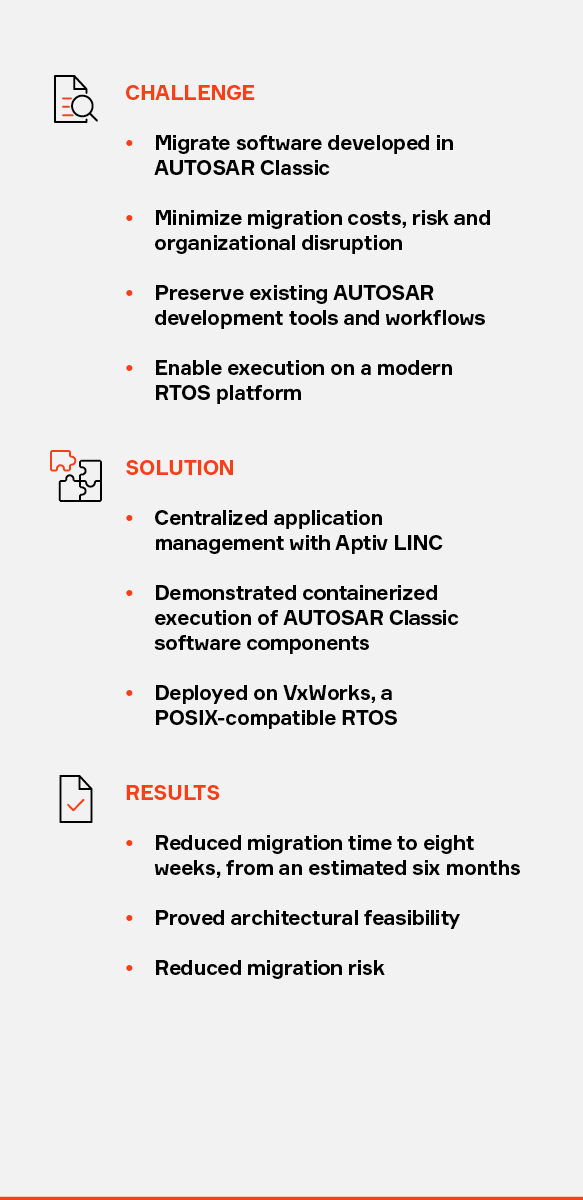
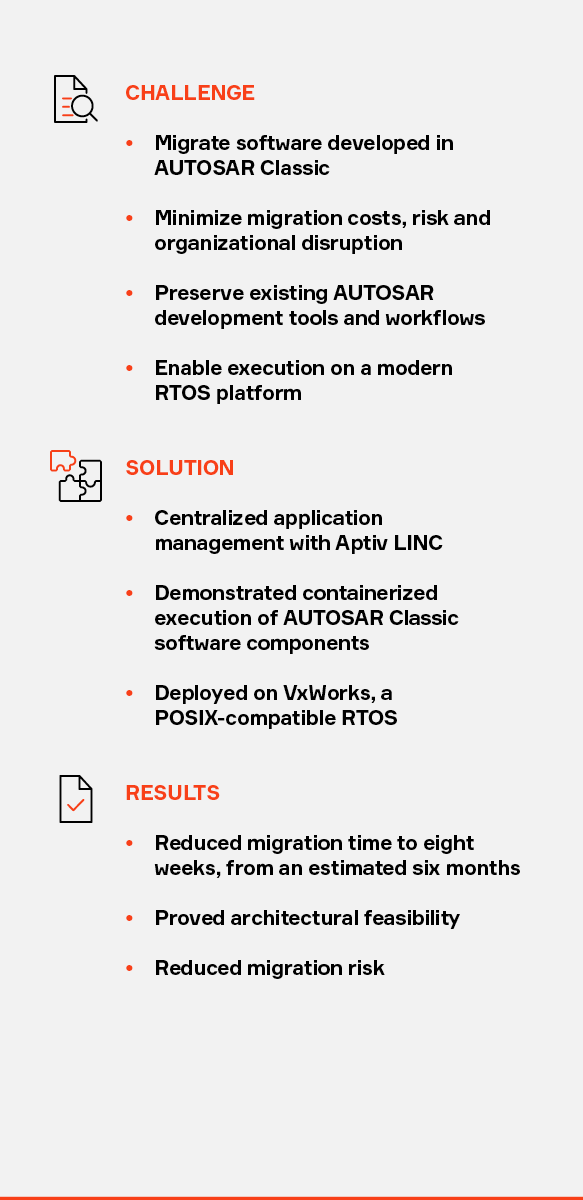
Challenge
- Migrate software developed in AUTOSAR Classic
- Minimize migration costs, risk and organizational disruption
- Preserve existing AUTOSAR development tools and workflows
- Enable execution on a modern RTOS platform
Solution
- Centralized application management with Aptiv LINC
- Demonstrated containerized execution of AUTOSAR Classic software components
- Deployed on VxWorks, a POSIX-compatible RTOS
Results
- Reduced migration time to eight weeks, from an estimated six months
- Proved architectural feasibility
- Reduced migration risk
The word AUTOSAR is a registered trademark of AUTOSAR GbR. All other trademarks are the property of their respective owners.