
Safety-Critical Systems Demand New Approach to Backup Power
Today’s vehicles increasingly include automated driving features and are moving toward hands-off or even fully autonomous driving. These technologies require high levels of functional safety so that a vehicle does not become a hazard in the event of a single-point or multipoint failure scenario. Designing for those scenarios presents major engineering challenges, including providing safety-critical components with highly reliable and fail-operational electrical power.
Enter the ultracapacitor — a compact, lightweight energy storage unit that can stabilize a vehicle’s 12V or 48V powernet while also supplying emergency power to safety-sensitive components should a collision or electrical failure occur. Coupling long-life ultracapacitors to the 12V powernet through a multiphase bidirectional DC-toDC converter allows the module to both absorb and deliver electrical power.
This approach has distinct advantages over battery technology. Ultracapacitors weigh less than lead-acid batteries, are less expensive than lithium-ion batteries, have a much longer lifespan than either type and are ideally suited for quick bursts of power.
In short, such a module is the natural choice to meet the requirements of today’s vehicles, which increasingly rely on electrical power to perform functions that are essential for consumers’ safety.
Redundancy Required
OEMs are increasingly equipping their automobiles with more active-safety devices and higher electrification. These features impose higher demands on a vehicle’s electrical system and increase the consequence of electrical power failure. In response, the industry is developing regulatory standards to reduce risk, such as requirements for electrical system redundancy.
Traditional vehicles satisfy the power redundancy requirements by having two power sources: a lead-acid battery (which is expected to transition to lithium-ion in future vehicles) and an alternator attached to an internal combustion engine (ICE). These power sources support the 12V powernet that connects to the electronic controls throughout the vehicle. For actual control of steering and braking, the two redundant sources are the advanced driver-assistance system and the human drivers themselves.
However, there are several limitations to this approach:
- Reliability. Battery trouble is often listed as a top cause of roadside breakdowns. For example, Transparency Market Research indicates that jump starts and battery assistance together were the top roadside service given in 2022, other than towing. Batteries have been shown to be maintenance-intensive, and any safety-critical functions of the car must be disabled until the operator services the battery. For some modern cars equipped with many electronic safety devices, that means the entire car might be unsafe to drive until a malfunctioning battery is serviced. And of course, a dead battery means a vehicle can’t start in the first place.
- Engine-off mode. Newer designs reduce fuel consumption using engine-off technologies, eliminating the alternator’s power contribution when the engine is not running. Engine-off mode also deactivates the power steering pump and the vacuum system used for braking, so it is typically used only when the vehicle is at a full stop. A weak battery might not be able to restart the engine, leaving a vehicle stranded in a roadway.
- Gliding. Many automakers are demonstrating “gliding,” where the engine may turn off during periods of zero torque demand. This may happen when the vehicle is motion, such as when the driver releases pressure on the accelerator pedal. In this case, the vehicle will lose power redundancy, power steering and braking ability when the engine turns off. Some automakers are therefore implementing two batteries in their ICE vehicles to maintain electrical redundancy.
The ideal solution would excel at providing quick bursts of power, have a long anticipated lifespan and be lighter and less expensive than competing solutions.
Battery electric vehicles use a high-voltage battery pack system and a large DC-to-DC converter to convert high-voltage power from the battery to 12V for the vehicle powernet. This is the primary power source, but the automaker must then also include a separate 12V battery for redundancy. The alternative solution is to use two DC-to-DC converters, but they must not share any common failure points in the high-voltage battery pack to maintain full redundancy. Plus, it is preferable to have dissimilar technologies providing the redundancy, so that the same conditions don’t necessarily cause the same failures in both.
Autonomous driving further increases the requirements for redundant power. Hands-free driving — that is, Level 3 or higher — requires not just redundant power sources but also redundant electrical systems. This can be imagined as a right-side and a left-side powernet, with each one having fully redundant power sources, fuse boxes and wire harnesses. If one of the powernets were to fail — for example, due to a collision — the powernet on the other side of the vehicle would continue to function. That way, the system could be fail-operational, and could potentially execute a minimum risk maneuver to bring the vehicle to a stop or transfer control to the human driver.
The Ultracapacitor Option
With so many critical functions in a vehicle increasingly dependent on uninterrupted electrical power, automakers require a solution that will continue to provide power even if the primary power source fails. The ideal solution would excel at providing quick bursts of power, have a long anticipated lifespan and be lighter and less expensive than competing solutions.
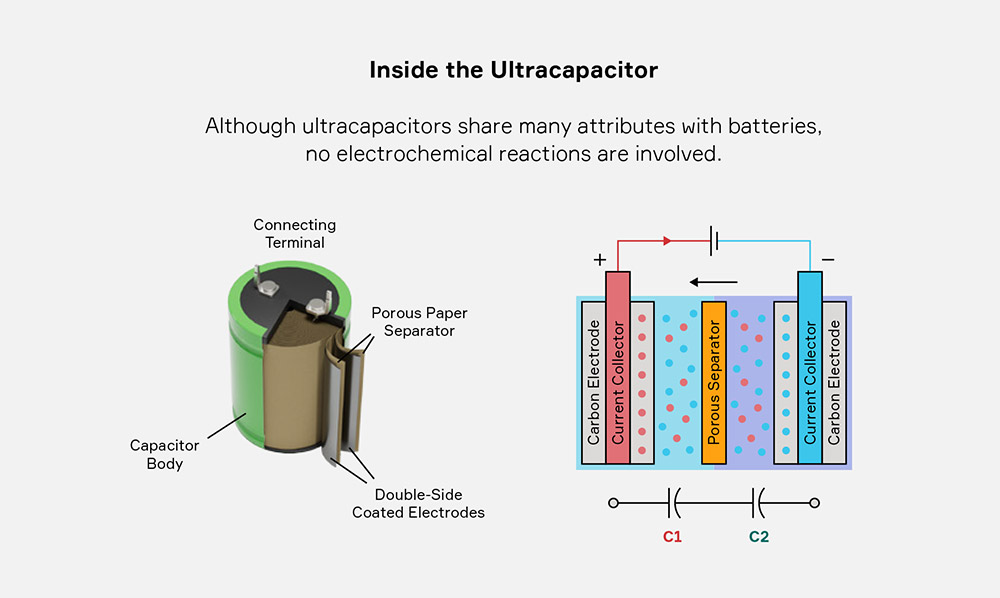
Ultracapacitors are far superior to batteries in all of these respects. They store positively and negatively charged ions and use a liquid electrolyte to facilitate the flow of energy — so, unlike in batteries, no electrochemical reactions are involved. This results in much faster charge and discharge times and makes ultracapacitors a natural choice for automotive applications that require bursts of power or quick storage, such as when energy is recaptured through regenerative braking.
Ultracapacitors weigh about 60 percent less than lead-acid batteries. Lithium-ion batteries, meanwhile, are expensive and cannot provide the same surge current that ultracapacitors or leadacid batteries can, especially at low temperatures.
Ultracapacitors also have a much longer lifespan than batteries because there are no physical or chemical changes speeding up degradation. A typical battery can handle several hundred to several thousand charge cycles, whereas an ultracapacitor can withstand more than 1 million. Ultracapacitors are more stable than batteries, do not contain heavy metals, and have an operating temperature range of between -40° C and 65° C.
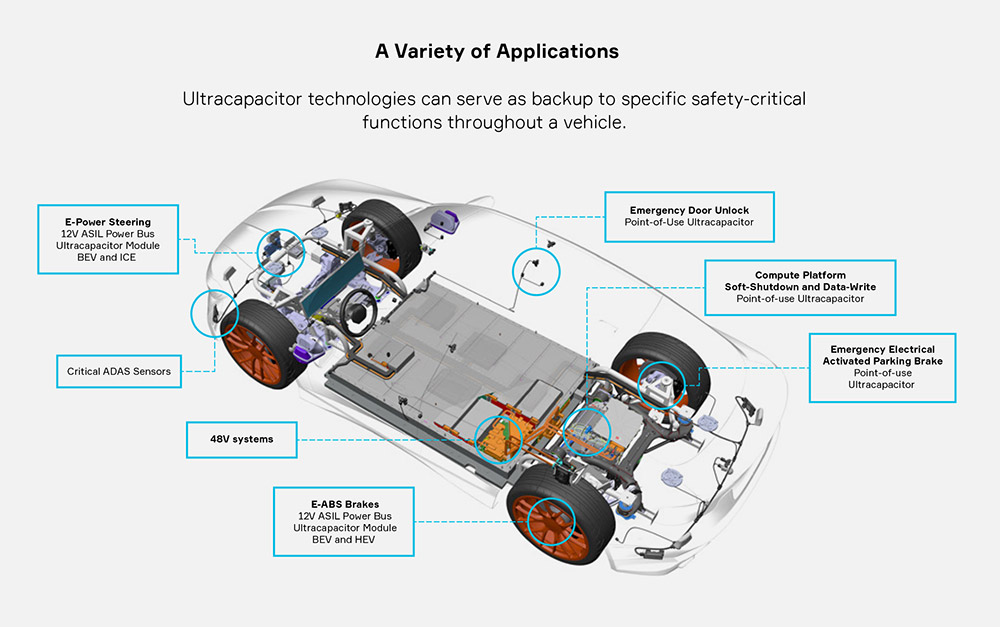
While the use of ultracapacitors in automotive applications has been limited, one successful and well-known ultracapacitor implementation in automobiles is the airbag. The airbag must function in even the worst of collisions, which may disable or incapacitate the vehicle’s electrical power system. Therefore, the airbag may contain an ultracapacitor to store electrical energy in case the vehicle’s electrical network is incapacitated, ensuring that a redundant, highly reliable power source is always available.
Ultracapacitors can be made large enough to provide backup power to other specific safety-critical functions, such as an electrically activated parking brake, an e-antilock braking system or an electrically activated transmission lock.
Batteries, in contrast, have had uneven performance in emergency scenarios. For example, a cellular emergency roadside service at one time incorporated a lithium-manganese dioxide nonrechargeable one-time-use battery. In an emergency situation where the vehicle power was incapacitated, the system could issue a final emergency beacon. Unfortunately, the lithium battery suffered lifetime problems, largely because the mounting location was subjected to sun exposure and high temperatures.
Unlocking its Potential
The energy storage and power delivery capabilities of an ultracapacitor are concentrated on the upper end of its operating voltage, according to the governing equation Joules (Energy) = 0.5 CV2, where C is the capacitance in Farads and V is the capacitor voltage. To make the most of an ultracapacitor, Aptiv controls its voltage by using a small, compact bidirectional DC-to-DC converter. This allows full utilization of the entire voltage band of the ultracapacitor, including the energy-dense top region. Since power is also a function of voltage, the higher the voltage the ultracapacitor is storing, the more power will be available.
Aptiv’s patent pending algorithm controls the DC-to-DC converter and ultracapacitor voltage, charging the ultracapacitor to the maximum possible voltage while also reserving a small amount of headroom in case a load transient occurs. If the module detects a spike on the powernet voltage, the DC-to-DC converter responds by absorbing the excess energy, storing it in the ultracapacitor’s reserve headroom. Similarly, if the module detects the powernet sagging into brownout territory, the DC-to-DC converter activates to pump charge out of the ultracapacitor to stabilize the bus voltage. In case of severe failures, the ultracapacitor will discharge the entirety of its energy to help maintain powernet voltage for as long as possible.
For example, one implementation can store 3,500 Joules (Watt-seconds), able to output in excess of 100 amps of current for a few seconds to keep the powernet alive. This is enough energy for an emergency anti-lock brake activation, electronic door unlock, electrically activated parking brake application, or for the central vehicle controller to data dump its memory banks. Called Aptiv Rapid Power Reserve (ARPR), the device continually computes its energy capacity and power delivery capability and can update the vehicle’s control computer in real-time.
Aptiv can scale the power capability of ARPR by varying the size of the ultracapacitors, the phases of the DC-to-DC converter, and control algorithm calibrations. ARPR can handle the inductive load dumps from steer-by-wire systems, filter bus voltage fluctuations, stabilize the bus voltage, and provide emergency power, all while performing self-diagnosis and providing realtime energy and power updates to critical vehicle systems.
Proof Points
Aptiv Rapid Power Reserve leverages ultracapacitor and DC-to-DC converter technologies to address the challenges of modern automotive evolution in the following ways:
- Highly reliable power delivery according to ISO 26262 functional safety criteria
- Maintenance-free and service-free performance for the duration of the automotive lifecycle (typically seven to 10 years), a metric that batteries cannot match
- Power delivery across a wide temperature range (typically -20° C to 55° C), which surpasses most battery chemistries except lead-acid
- Delivery of enough energy to perform the final safety-critical functions of a vehicle that is experiencing incapacitation or multiple failure modes, which usually lasts for milliseconds or seconds
- High power density that can discharge in times ranging from milliseconds to seconds
- Lighter weight and a smaller volumetric footprint than lithium-ion battery types, which are designed to discharge over many minutes or hours instead of milliseconds or seconds
- Lower cost than other redundant power sources, such as lithium-ion batteries or redundant DC-to-DC converters
The Right Choice
The combination of long life and wide operating temperatures make the ultracapacitor module an attractive redundant energy storage solution to supply point-source power for critical safety loads.
Aptiv Rapid Power Reserve is an ultracapacitor module that provides instantaneous backup power to safety-critical systems such as steering and braking. Aptiv’s solution combines battery management control software with power electronics to deliver maximum performance at an optimized cost and power density. As the only supplier of both the brain and the nervous system of the vehicle, Aptiv is uniquely positioned to provide solutions that optimize the entire vehicle architecture.