USB Power Delivery: Plugging Into the Benefits
In the late 20th century, peripherals such as keyboards, headphones and storage devices required various cables and connectors to connect to computers. The industry needed to simplify and consolidate those connectors — and, with its introduction in 1996, the Universal Serial Bus (USB) standard began to establish itself as the default choice for electronic devices.
However, the connector’s predictable, interoperable plug and small size were merely its most visible advantages. USB also became an industry standard for powering devices — and its importance has only increased as rechargeable devices such as smartphones have proliferated with ever-expanding battery capacity. Each iteration of USB has improved its ability to deliver power faster — and more improvements are coming soon.
USB Power Delivery (PD) and USB Extended Power Range (EPR), the next steps in the technology’s evolution, are set to create faster, more powerful wired connections. USB PD and EPR have implications for a range of media modules across markets as disparate as automotive, consumer devices and commercial aerospace.
Many manufacturers’ design specifications for upcoming hardware incorporate the newest standards, and some are already on the consumer market. Certified products are expected to arrive by 2029, bringing faster device charging and data transfer to OEMs and the consumers they serve, as well as to other markets, including the manufacturing and defense industries. Anyone planning strategy for electronic devices should be aware of where things stand, with special attention paid to charging features.
The Power of USB-C
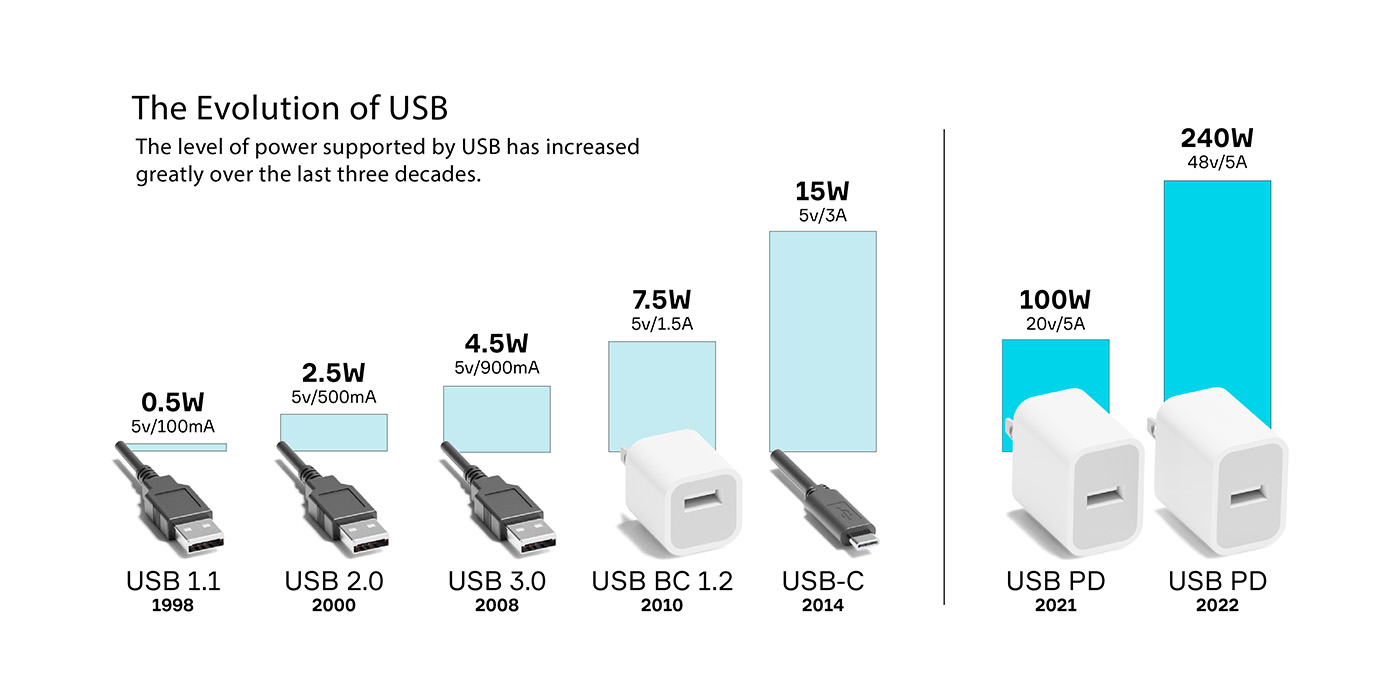
Early charging capabilities were limited. USB 1.1 (USB-A) could supply a trickle charge, with 0.5W of power. USB 2.0 brought the power level up to 2.5W, but a non-USB adapter would still charge a cellphone faster. USB-C, released in 2014, introduced a 15W power supply.
The USB PD protocol, announced in 2021, works with certified USB-C cables and connectors, enabling devices to negotiate for optimal power delivery. USB PD supports up to 100W — a huge jump — which it accomplishes by increasing the voltage step from 5V to 20V while keeping the electric current the same on USB-C cables. USB PD also supports bidirectional charging.
USB EPR builds on USB PD to support charging higher-power devices — including some laptops, monitors and other peripherals — via a single USB-C port. With USB PD and EPR, fixed voltages enable up to 140W, 180W and 240W power levels. An adjustable voltage supply mode permits devices being powered to request intermediate voltages, starting at 9V and increasing up to 48V.
Optimizing the connection to provide the maximum power and functionality is an electronic negotiation process that touches on everything from the device’s ambient temperature to adjustments to maintain the correct voltage. But in the end, the device being charged requests power, and the charging device can supply only up to the requested amount.
Any advance in charging technology is meaningful. For example, consider a consumer electronics device that supports up to 40W wired charging over USB-C (when using a USB-C PD charger that has the appropriate rating). With a certified charger and cable, the device could reach a 50 percent charge in about 20 minutes — a clear improvement over previous generations of such technologies, which would often take hours.
Power Sharing
Aptiv also uses USB-C to offer power sharing, which maximizes device charging while minimizing size, cost, battery current and heat. Multiple devices can get power over USB simultaneously, eliminating the need for a dedicated AC adapter for each device. That means that a single charger allocates power per port as necessary. USB PD has “power rules” to dictate the behavior of compliant power sources.
That is where the nuances of USB PD implementation come in. With the specification increasing to 240W, automotive suppliers and manufacturers must find the most efficient way to transfer power. Power sharing ensures maximum power output per connected port.
Aptiv was among the first companies to produce a standards-compliant product, which was developed in partnership with an OEM. Using dual-port modules, the system recognizes that, say, one smartphone battery in the vehicle is at 5 percent of capacity and a second phone is at 75 percent. The programming module gives the former device 100W and the latter 25W. In addition to creating more satisfied drivers and passengers, using power sharing with smart load shedding means that the OEM does not need support for additional 240W ports. It can reuse electronics in the bill of materials and reduce costs — while adding the convenience of having more ports.
There are more opportunities, accompanied by more complexity. The USB Type-A pinout has four pins — one for power, one for ground and two for data. In contrast, USB-C has 24 pinouts, which adds flexibility as well as other features beyond those of the traditional four-pin USB-A connector.
The Standard Players
Although the newest USB standards were set in 2021, devices that take full advantage of their features are only now going through the certification process. The Battery Charging 1.2 Test Procedures date from September 2025, for example.
The first automotive deployments of USB PD and EPR are in production and have been certified. With such complicated systems, those requirements must dovetail with other safety and security standards. The same applies to other industries planning to implement new USB features, whether airline cockpits, power-hungry medical devices or industrial NFC/RFID sensors.
The nonprofit USB Implementers Forum (USB-IF) facilitates the standards’ development and has logo and compliance programs. The related USB Promoter Group develops specification addenda to extend or adapt the technology’s specifications or use cases. Essentially, the Promoter Group sets the rules, and USB-IF ensures that the industry follows them.
The compliance process involves dozens, if not hundreds, of tests for any given device. If an organization wants to achieve USB-IF compliance for, say, a two-port device (and thus acquire permission to use the USB-IF logo on its packaging, the device must be rigorously tested at different frequencies and power loads to validate that it is an efficient and safe product, based on specific criteria. For instance, the device’s power transfer might be required to adhere to a transition in a quarter of a second.
Given the success of USB-C connectors, standards bodies are looking at potentially eliminating yet another cable. For example, the same port that charges cellphones could mirror a laptop screen to a TV or a display screen, using high-speed data lanes to transport audiovisual data. That is the intended role for DisplayPort Alternate Mode: to enable certain USB-C ports to send video signals to external monitors using the DisplayPort protocol, all through a single cable.
Aptiv has been active in standards committees since 2012, in part because the automotive industry has strict requirements. That core membership — and an enthusiasm for exploring what is possible — gives us advantages in understanding the new USB standards, envisioning what can be accomplished with them and being first to market with those innovations.