Solving a Critical EV Safety Challenge: Post-Crash Door Unlocking
Electronic door systems look sleek and reduce wind drag. But if the electronics fail in a crash, there is often no obvious mechanical way for occupants to escape or any way for first responders to pull them free.
The issues are not just theoretical. In the wake of several preventable deaths, governments around the world are putting new safety regulations in place. China is leading the way, with legal requirements taking effect on January 1, 2027. This, in turn, has put time and cost pressures on OEMs: How do they make electronic handles safer without having to redesign the entire electronics architecture?
Engineering Redundancy for the Electric Era
To address these challenges, Aptiv developed a unique solution called the Emergency Power Module (EPM), which provides both independent, reliable backup power and door unlocking without requiring that the electronics system be reworked. This product has since been launched with a leading Chinese OEM.
In many vehicles, door unlocking depends on a single body controller and a single power source, often located at the front or rear of the vehicle. In a major crash, these components and their harnesses can be damaged, preventing the unlock command or the required power from reaching the doors.
To reduce this risk, Aptiv designed the EPM as a compact module that works separately from the existing body controller. It continuously monitors for crash signals and messages from both the CAN FD (Controller Area Network with Flexible Data-Rate) bus and a direct hardware signal from the airbag system.
If the vehicle integration unit (VIU) is disabled, it loses the ability to control the door-unlock motors. However, the EPM can independently trigger the unlock sequence based on the airbag crash signal, providing an alternate path for door unlocking. When a crash is detected, the EPM delivers a short burst of power to unlock the doors.
The EPM uses ultracapacitors, also called electric double-layer capacitors (EDLC), as a temporary energy source. Compared with lithium-ion batteries, EDLC technology offers faster discharge, higher power density, better inherent safety and a longer lifespan, making it well suited for short, high-reliability events, such as powering door locks in the aftermath of a crash.
Collaboration and Design Refinement
Close collaboration between the Chinese OEM and Aptiv was essential to bringing the EPM concept into production. The two companies’ engineering teams jointly defined how the EPM should behave in different crash scenarios, how it should interact with the existing VIU and how it could be packaged inside the passenger cabin. The compact module was designed to fit under a typical passenger seat to minimize the risk of it being damaged in a crash.
To deploy the solution, the team had to balance several trade-offs. One challenge was coordinating the mechanisms’ behavior when the VIU remains operational after a crash. If both the VIU and the EPM attempted to control doors at the same time, there was a risk of a short circuit or a voltage back surge. Aptiv and the OEM addressed this by introducing protection mechanisms and a delayed-unlock strategy that staggers how each system issues its commands. They later refined the architecture to improve energy efficiency, enabling more of the ultracapacitor’s stored energy to be used for door unlocking without adding complexity for the OEM.
Lessons for Future EV Safety Designs
The EPM project showed that a dedicated redundancy solution for door unlocking can be added in a way that is both practical to integrate and meaningful for occupant safety. It also demonstrated how targeted backup modules can enhance crash-time functionality without requiring a complete rework of existing body electronics.
While the true value of such a system is fully visible only in severe crash events, the absence of reported cases where doors could not be opened on the vehicle lines that now include EPMs is an encouraging sign. Both the OEM and Aptiv now see opportunities to extend the concept to additional functions that require emergency power, such as window lowering or emergency call activation, and to incorporate similar redundancy into future architectures.
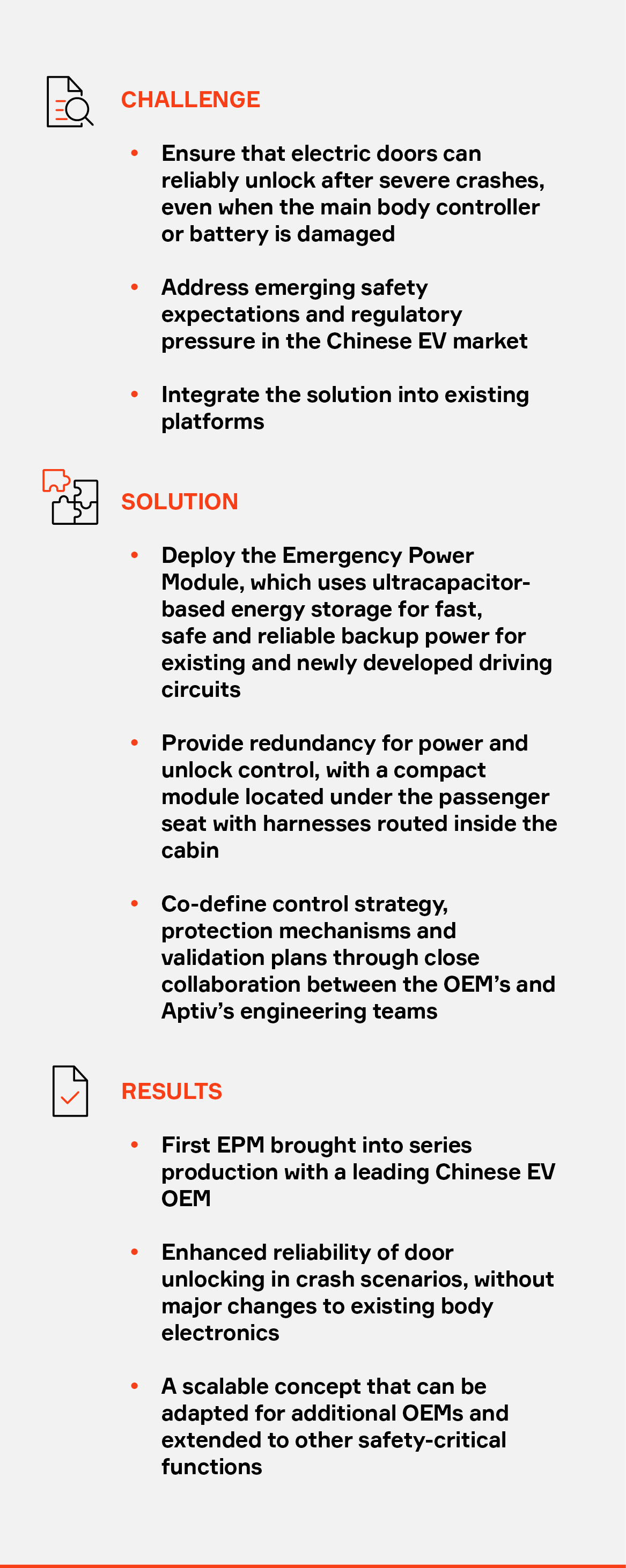
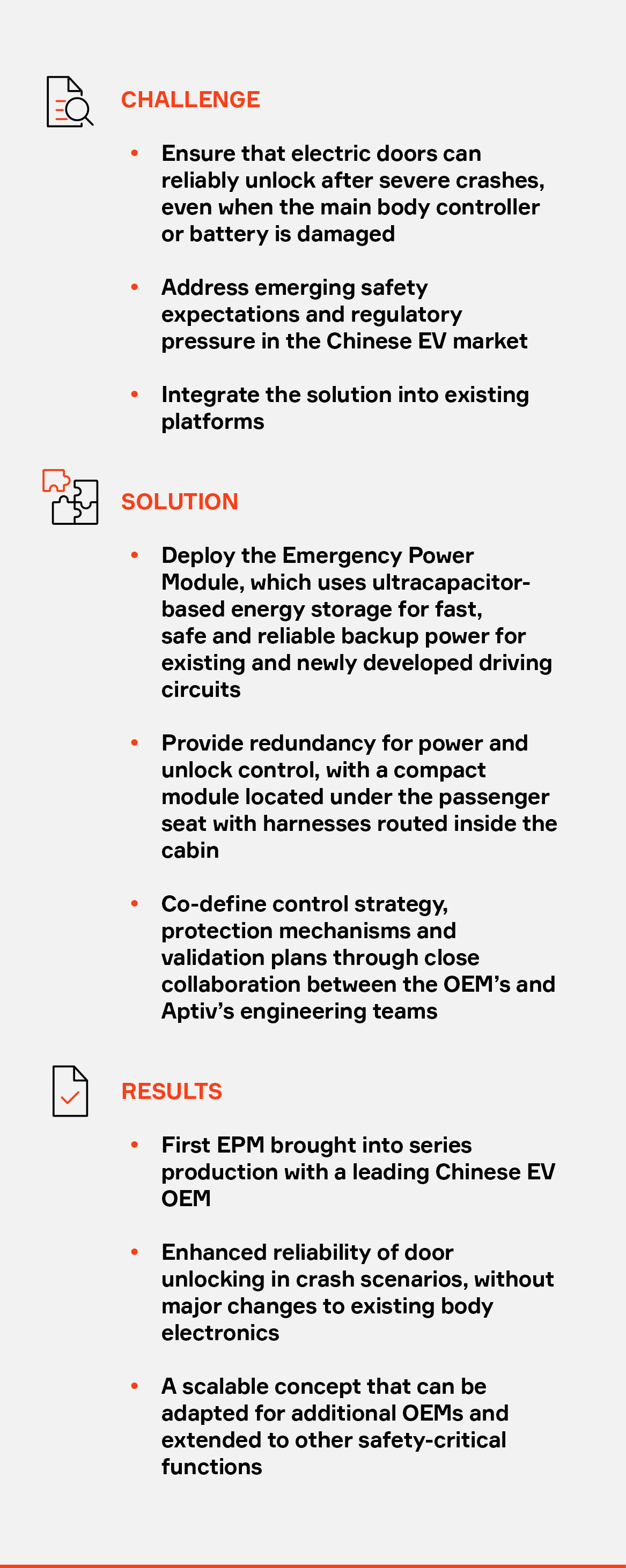
Challenge
- Ensure that electric doors can reliably unlock after severe crashes, even when the main body controller or battery is damaged
- Address emerging safety expectations and regulatory pressure in the Chinese EV market
- Integrate the solution into existing platforms
Solution
- Deploy the Emergency Power Module, which uses ultracapacitor-based energy storage for fast, safe and reliable backup power for existing and newly developed driving circuits
- Provide redundancy for power and unlock control, with a compact module located under the passenger seat with harnesses routed inside the cabin
- Codefine control strategy, protection mechanisms and validation plans through close collaboration between the OEM’s and Aptiv’s engineering teams
Results
- First EPM brought into series production with a leading Chinese EV OEM
- Enhanced reliability of door unlocking in crash scenarios, without major changes to existing body electronics
- A scalable concept that can be adapted for additional OEMs and extended to other safety-critical functions