Spot Coating Helps EV Manufacturer Reduce Material Use in Busbars

Spot Coating Helps EV Manufacturer Reduce Material Use in Busbars

Spot Coating Helps EV Manufacturer Reduce Material Use in Busbars 

A North American electric vehicle manufacturer wanted to support large-scale production programs while reducing their environmental impact. One area of focus was busbars, a major component of high-voltage electrical architectures that transfers power to key vehicle systems.

Busbars are long, solid metal conductors. To prevent corrosion, maintain stable electrical connections and ensure long-term durability, part of the manufacturing process is to apply a protective coating to the busbars.

Aptiv developed and optimized a spot coating process for busbar applications that eliminates water consumption and lowers emissions without compromising performance.

Manufacturers traditionally coat busbars through a rack coating process. During this process, they immerse each component in multiple chemical baths and use electricity to apply a uniform layer of nickel, tin or other protective material. Although effective, this process coats far more surface area than the application requires.

Many busbar applications require protection only at the connection points where electrical contact occurs. When manufacturers coat the entire busbar, they increase material consumption and use significant amounts of water and energy. As vehicle programs scale into hundreds of thousands of units, the unnecessary coatings create a larger environmental impact.


A Breakthrough in Sustainable Manufacturing

Aptiv’s spot coating process applies protective material only where it is needed to overcome the limitations of traditional coating methods.

The process begins with sandblasting, which removes any existing oxidation and creates a rough contact surface. Then, the system feeds a coating material into an arc spray device, where an electric arc melts the material. Compressed air deposits the molten material onto specific areas of the busbar — targeting only the connection points.

This approach ensures corrosion resistance, contact stability and durability while significantly reducing resource consumption. Because the process eliminates chemical baths, it removes the water-intensive treatment stages associated with classic galvanization.
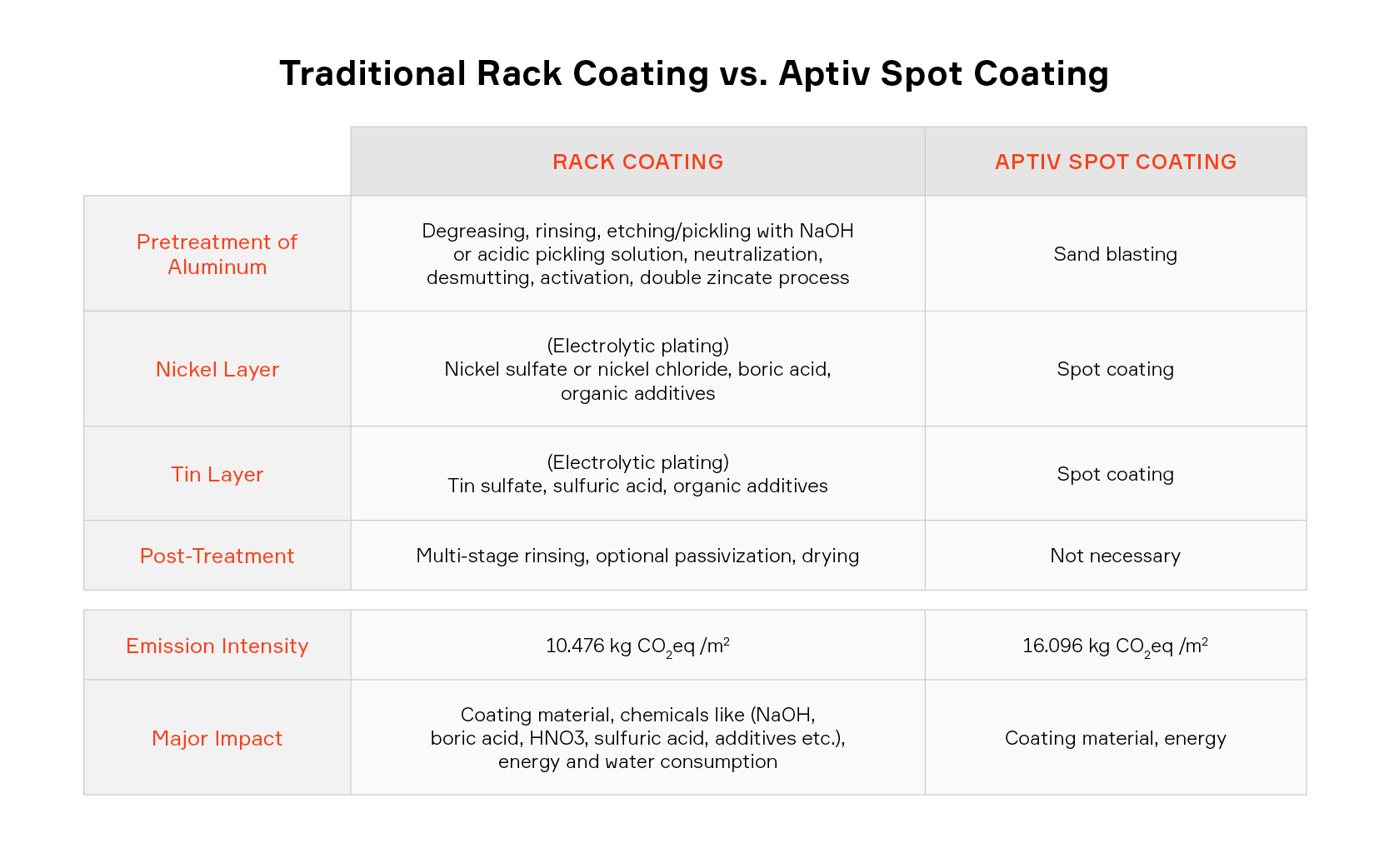
Traditional Rack Coding vs. Aptiv Spot Coating graphicA comparison of traditional rack coating and Aptiv’s spot coating process. Unlike traditional rack coating, which covers the entire busbar, Aptiv’s spot coating process applies nickel and tin only to connection areas, reducing the amount of coated surface throughout the product lifecycle.


Dramatic Results

Aptiv evaluated the impact of spot coating across two of the manufacturer’s electric vehicle programs, scheduled to run from 2026 through 2030. Across both programs, conventional rack coating would have required approximately 160,000 square meters of coated busbar surface. By coating only the areas required for electrical contact, Aptiv reduced the coated area to approximately 2,400 square meters.

Over the lifetime of the programs, Aptiv’s approach reduces the coated surface area by 98 percent and has several substantial environmental benefits: It reduces CO2-equivalent emissions by 97 percent over the project lifetime; it eliminates process water consumption compared to traditional coating processes that can require 50 to 150 liters of water per square meter; and it reduces chemical usage by eliminating multiple chemical bath stages.

Although spot coating generates a higher emissions intensity per square meter, the process dramatically reduces the amount of coated surface required. By applying protection only where it is needed, Aptiv developed a more resource-efficient solution that supports vehicle performance and sustainability goals.


Challenge

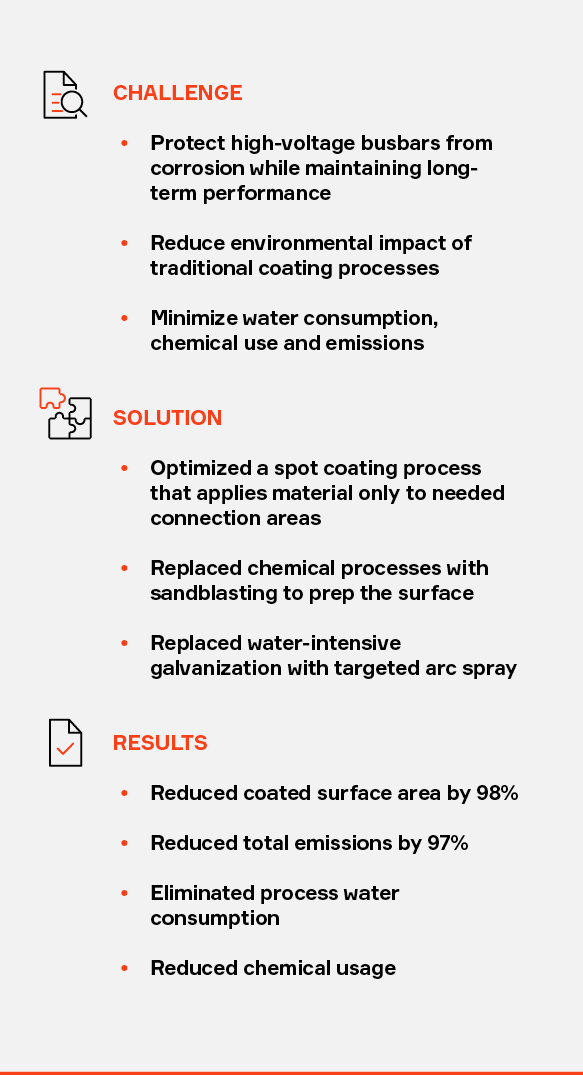
  • Protect high-voltage busbars from corrosion while maintaining long-term performance
  • Reduce environmental impact of traditional coating processes
  • Minimize water consumption, chemical use and emissions

Solution

  • Optimized a spot coating process that applies material only to needed connection areas
  • Replaced chemical processes with sandblasting to prep the surface
  • Replaced water-intensive galvanization with targeted arc spray 

Results

  • Reduced coated surface area by 98%
  • Reduced total emissions by 97%
  • Eliminated process water consumption
  • Reduced chemical usage 

A North American electric vehicle manufacturer wanted to support large-scale production programs while reducing their environmental impact. One area of focus was busbars, a major component of high-voltage electrical architectures that transfers power to key vehicle systems.

Busbars are long, solid metal conductors. To prevent corrosion, maintain stable electrical connections and ensure long-term durability, part of the manufacturing process is to apply a protective coating to the busbars.

Aptiv developed and optimized a spot coating process for busbar applications that eliminates water consumption and lowers emissions without compromising performance.

Manufacturers traditionally coat busbars through a rack coating process. During this process, they immerse each component in multiple chemical baths and use electricity to apply a uniform layer of nickel, tin or other protective material. Although effective, this process coats far more surface area than the application requires.

Many busbar applications require protection only at the connection points where electrical contact occurs. When manufacturers coat the entire busbar, they increase material consumption and use significant amounts of water and energy. As vehicle programs scale into hundreds of thousands of units, the unnecessary coatings create a larger environmental impact.


A Breakthrough in Sustainable Manufacturing

Aptiv’s spot coating process applies protective material only where it is needed to overcome the limitations of traditional coating methods.

The process begins with sandblasting, which removes any existing oxidation and creates a rough contact surface. Then, the system feeds a coating material into an arc spray device, where an electric arc melts the material. Compressed air deposits the molten material onto specific areas of the busbar — targeting only the connection points.

This approach ensures corrosion resistance, contact stability and durability while significantly reducing resource consumption. Because the process eliminates chemical baths, it removes the water-intensive treatment stages associated with classic galvanization.

Traditional Rack Coding vs. Aptiv Spot Coating graphicA comparison of traditional rack coating and Aptiv’s spot coating process. Unlike traditional rack coating, which covers the entire busbar, Aptiv’s spot coating process applies nickel and tin only to connection areas, reducing the amount of coated surface throughout the product lifecycle.


Dramatic Results

Aptiv evaluated the impact of spot coating across two of the manufacturer’s electric vehicle programs, scheduled to run from 2026 through 2030. Across both programs, conventional rack coating would have required approximately 160,000 square meters of coated busbar surface. By coating only the areas required for electrical contact, Aptiv reduced the coated area to approximately 2,400 square meters.

Over the lifetime of the programs, Aptiv’s approach reduces the coated surface area by 98 percent and has several substantial environmental benefits: It reduces CO2-equivalent emissions by 97 percent over the project lifetime; it eliminates process water consumption compared to traditional coating processes that can require 50 to 150 liters of water per square meter; and it reduces chemical usage by eliminating multiple chemical bath stages.

Although spot coating generates a higher emissions intensity per square meter, the process dramatically reduces the amount of coated surface required. By applying protection only where it is needed, Aptiv developed a more resource-efficient solution that supports vehicle performance and sustainability goals.


Challenge

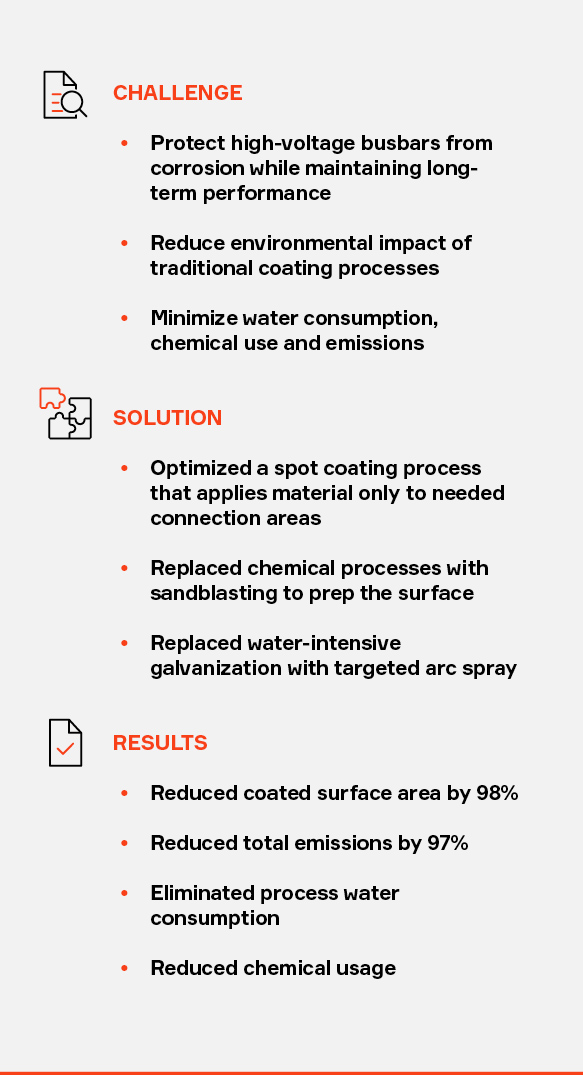
  • Protect high-voltage busbars from corrosion while maintaining long-term performance
  • Reduce environmental impact of traditional coating processes
  • Minimize water consumption, chemical use and emissions

Solution

  • Optimized a spot coating process that applies material only to needed connection areas
  • Replaced chemical processes with sandblasting to prep the surface
  • Replaced water-intensive galvanization with targeted arc spray 

Results

  • Reduced coated surface area by 98%
  • Reduced total emissions by 97%
  • Eliminated process water consumption
  • Reduced chemical usage 
How helpful was this article?
i


×

Please let us know how helpful this article was, so we can provide you with the best content possible. If you have more feedback to share, please feel free to contact us.
Thank you!

Careers


Shape the future of mobility. Join our team to help create vehicles that are safer, greener and more connected.

View Related Jobs