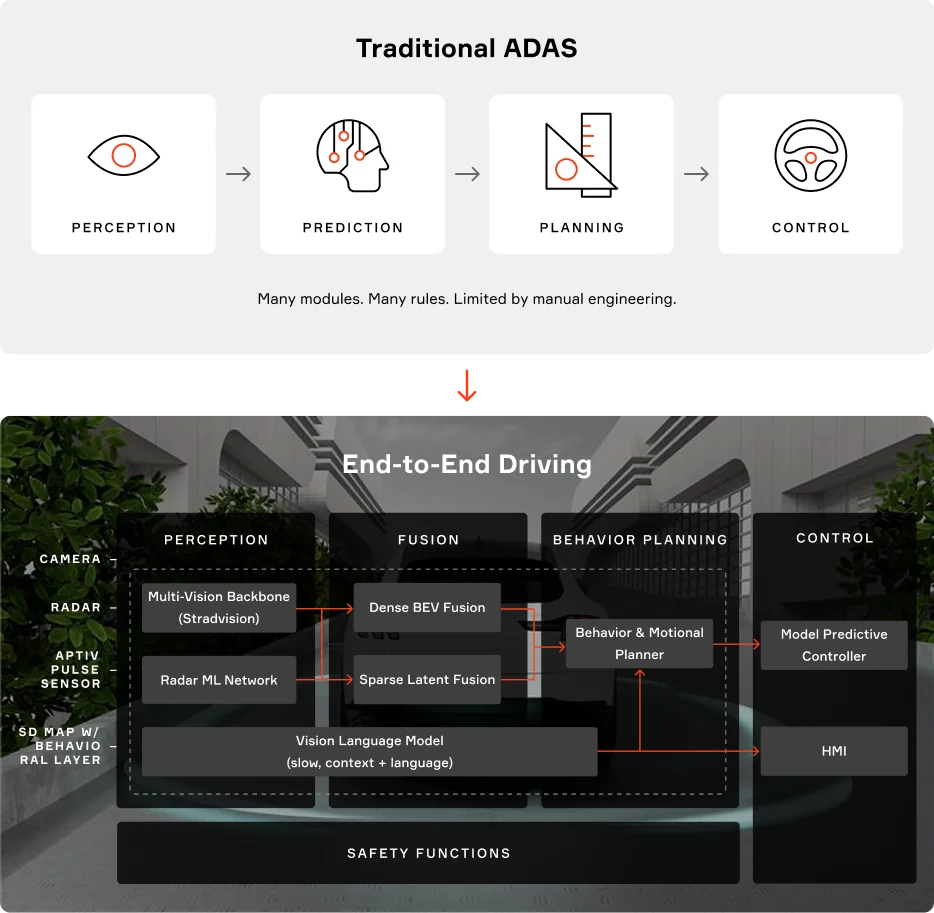
Traditional ADAS architectures process information by following a series of distinct steps: Sensors collect data; perception software identifies objects; fusion software combines information from different sensors to build an environmental model; planning algorithms determine the safest path forward; control systems execute maneuvers. Each stage is developed and optimized largely independently.
With end-to-end AI, ADAS is structured differently. Rather than compartmentalizing the functions that ADAS comprises and manually writing rules for every possible driving scenario, developers train AI models holistically, across perception, prediction and planning.
Why Rules Reach Their Limits
Rule-based systems work well for tasks where a scenario and desired response are well understood. For example, if a driver fails to respond when the vehicle ahead stops suddenly, the automatic emergency braking system will apply the brakes.
But problem-solving is more complicated when driving moves beyond relatively common and structured situations. Engineers cannot realistically anticipate every permutation of traffic, weather, infrastructure and human behavior. How should a vehicle behave on unstructured roads? What is the best response when road users behave unpredictably? The number of possible situations is practically infinite, particularly as the vehicle takes on ever greater portions of the driving tasks.
That complexity is one reason for the adoption of end-to-end AI. Instead of attempting to codify every possibility, ADAS developers and engineers can train automotive systems to recognize patterns captured in massive datasets and learn behaviors that can be applied to new situations and levels of functionality.
Building a Digital Understanding of the World
Today, ADAS relies on sensor fusion to create a digital understanding of the environment and to build a three-dimensional representation of the world around the vehicle. Deterministic algorithms that combine sensor-data inputs are able to fuse and analyze raw radar data, camera images, as well as lidar data and maps when available to establish algorithmic confidence about tracking accuracy and classification.
End-to-end AI adds a new ingredient to ADAS architectures. It helps the systems learn how to interpret a much wider variety of conditions while also incorporating perception with control and decision-making into a combined set of models. That moves ADAS toward driving that can naturally adapt to complex urban scenarios without the need for high-definition maps.
End-to-end systems typically do not control the vehicle using only machine learning. Vehicle control often continues to rely on proven control theory and established safety methodologies. Rule-based safety mechanisms remain in place to validate actions and intervene when necessary. Safety overrides take priority over learned behavior.
The result is not merely object detection. It is a continuously evolving model of the driving environment and of predictions about how that environment could change.
Why the Black Box Is Not Enough
A common misconception is that end-to-end AI means handing everything to an opaque neural network. Many engineers reject that approach.
Instead, they pursue architectures that preserve interpretability while still benefiting from end-to-end learning. Machine learning components can generate understandable outputs, such as detected vehicles, lane boundaries, predicted trajectories and planned maneuvers. Those outputs help engineers validate performance, diagnose problems and understand why the system made a particular decision.
That transparency becomes increasingly important as systems become more capable. If a vehicle changes lanes unexpectedly or chooses a route that a driver would not have selected, both engineers and customers benefit when the reasoning behind the decision can be understood.
Future systems may become increasingly personalized. They may learn preferred routes, driving characteristics and behavioral preferences over time. The ability to adapt to individual drivers could become a significant differentiator, once baseline driving capability reaches maturity.
Building Trust Alongside Intelligence
End-to-end AI for ADAS is more a systems shift than a technology shift. It changes how driving software is developed, how vehicles learn, how safety is validated and how people interact with automation. The promise is broader operational domains, faster learning cycles, improved scalability and more natural driving behavior.
However, success depends on more than machine learning performance. The goal is to enable natural, humanlike driving, with smooth maneuvers, confident decisions, and behavior that feels intuitive on real roads. And, thanks to AI, progress along that path is well underway.
What End-to-End Really Means