
In-cabin sensing has become essential for achieving high safety ratings and meeting evolving regulatory requirements. Consumer-vehicle rating programs, such as Euro NCAP and C-NCAP, along with regulatory requirements, such as FMVSS 208, are placing more emphasis on understanding vehicle occupants to enable more intelligent and adaptive protection systems.
Here is an overview of how vehicle rating programs and regulatory requirements are influencing in-cabin sensing today.
Euro NCAP
Among today’s consumer vehicle safety assessment programs, the European New Car Assessment Programme (Euro NCAP) has a particularly strong influence on the adoption of in-cabin sensing technology. Euro NCAP’s 2026-2028 protocols place increased emphasis on driver engagement and occupant monitoring, including functions such as occupant classification, child presence detection and passenger airbag management. As a result, OEMs’ incentives to invest in advanced interior sensing capabilities are growing.
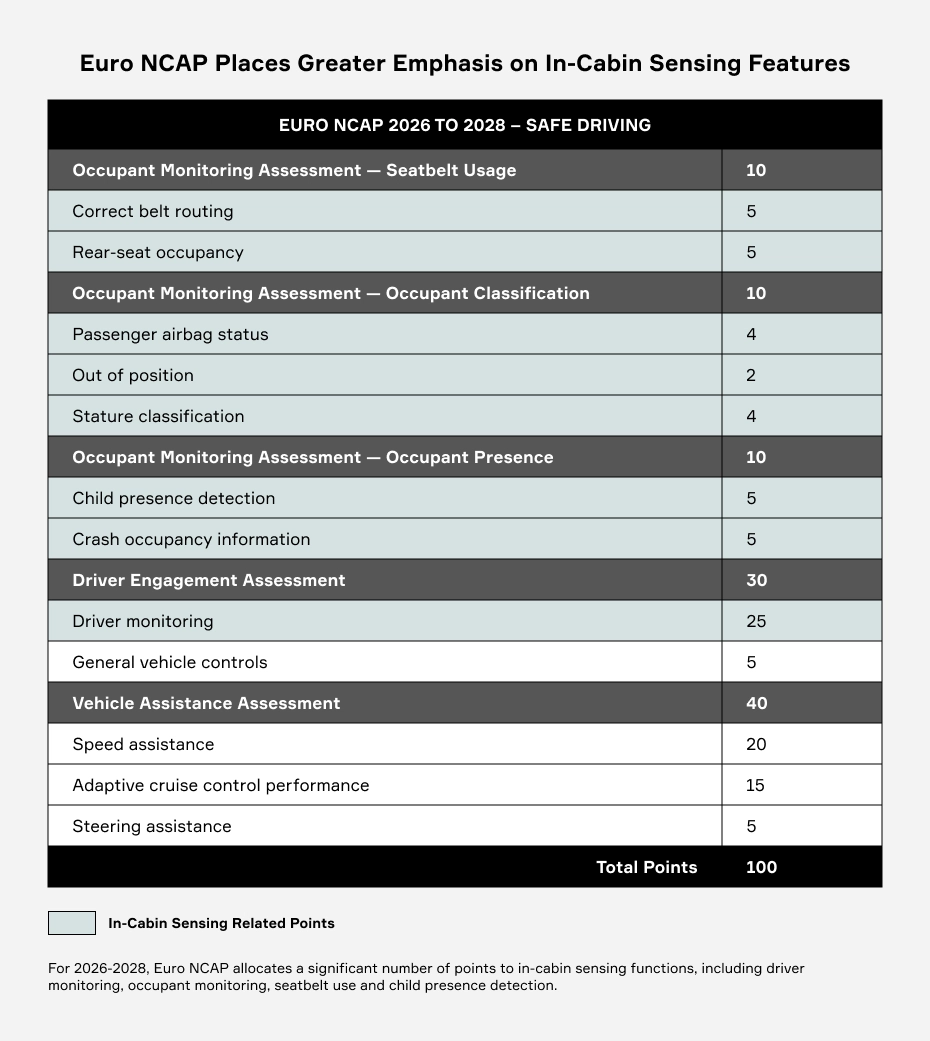
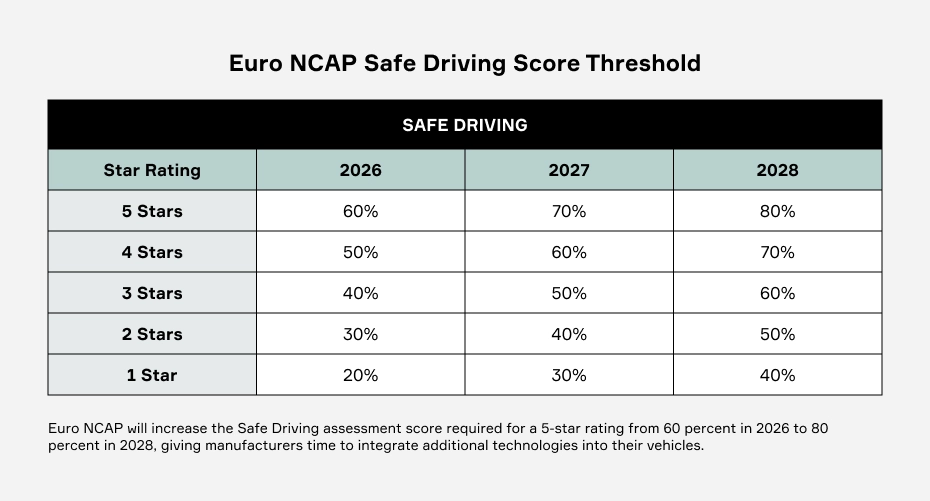
Euro NCAP allocates a substantial amount of the 100 Safe Driving points within the Safe Driving pillar to features related to in-cabin sensing. Those points cover capabilities such as driver distraction detection, drowsiness detection, seat-belt reminder systems, occupant monitoring and child presence detection. A configuration designed to perform well under the Euro NCAP assessment may combine a driver monitoring camera with occupant-sensing capabilities that can detect driver distraction, seat-belt usage and occupied seating positions throughout the cabin. To give manufacturers time to integrate these technologies into their vehicles, Euro NCAP will gradually increase the Safe Driving score required to achieve a 5-star rating by 10 percent per year from 2026 through 2028.
FMVSS 208
In the United States, FMVSS 208 establishes mandatory guidelines for occupant crash protection. To comply with FMVSS 208 requirements, OEMs often use occupant-sensing systems that determine occupant presence and classification to help vehicles make appropriate airbag and restraint decisions during a crash. The regulation also requires airbag systems to account for a range of occupants, including children and smaller adults. Interior sensing supports these requirements by providing accurate information about occupant presence, position and classification, which help vehicles make smarter airbag and restraint decisions when a crash occurs.
C-NCAP
C-NCAP reflects China’s growing focus on driver monitoring technology. The protocol includes a comprehensive driver monitoring system evaluation framework assessing fatigue detection, distraction detection, system warnings, intervention functions and false-response performance. Test scenarios require systems to detect behaviors such as prolonged eye closure, looking away from the road, looking toward a phone charging location and other evidence of driver distraction. The protocol also includes occupant posture monitoring and seat-belt misuse assessments. Additional points are available (see Appendix N) for systems that detect unsafe passenger positions, such as a passenger sitting too close to an airbag or placing their feet on the instrument panel, as well as seat-belt misuse scenarios, including routing the shoulder strap under the arm or fastening the belt behind an occupant.
C-NCAP places significant emphasis on driver attention monitoring while also expanding the assessment of occupant posture, restraint use and occupant protection. Together, these developments align with the broader global trend of using interior sensing technology to improve vehicle safety.
What Comes Next?
Euro NCAP’s published roadmap points toward continued development of in-cabin sensing beyond the current assessment cycle. While the detailed content of future protocols has not yet been established, the industry is preparing for in-cabin sensing to play a broader role in vehicle safety.
An important aspect is the closer integration of driver monitoring with ADAS. Information about driver attention and alertness could help vehicles determine how and when to provide warnings or interventions. Having such data would create opportunities to improve safety performance while reducing alerts that are unnecessary or not relevant to the immediate situation.
Industry trends suggest that occupant monitoring may continue to evolve beyond basic occupancy and restraint-status detection toward a more comprehensive understanding of cabin conditions. More advanced sensing technologies could support safety systems by providing additional information about occupant characteristics, seating conditions and other factors relevant to occupant protection.
As these capabilities advance, in-cabin sensing will become an integral part of the vehicle’s safety architecture. The long-term opportunity is to connect information about the driver, occupants and environment so that active and passive safety systems can respond more intelligently.
For vehicle manufacturers, this means that future-ready in-cabin sensing should be designed as a scalable source of safety-relevant information across the vehicle. And as these systems become increasingly prevalent, they open opportunities to offer new, value-added features.
How OEMs Can Prepare Today
Although vehicle rating criteria and safety regulations continue to evolve, OEMs can benefit from preparing for new requirements and assessment protocols before they take effect.
The most important action involves selecting sensing platforms and vehicle architectures that can support future capabilities, through software updates and system enhancements. OEMs that build flexibility into their vehicle architectures today will be able to adapt more smoothly as standards change over time.
OEMs should also consider solutions that use a single sensing platform to support multiple use cases. Driver monitoring, occupant monitoring, occupant classification and emerging regulatory and vehicle rating expectations all rely on understanding who sits in the vehicle and how they interact with the cabin environment.
Euro NCAP, FMVSS 208 and C-NCAP collectively reflect an industry shift toward greater awareness inside the vehicle.
Aptiv’s in-cabin sensing solutions for driver and cabin monitoring help manufacturers comply with emerging regulatory requirements and achieve leading safety ratings. Aptiv’s Advanced Occupancy Classification (AOC) solution helps vehicles understand occupants and provides information that supports occupant protection strategies. Combined with driver and occupant monitoring capabilities, AOC gives manufacturers a flexible foundation for meeting current requirements while preparing for emerging expectations around occupant classification, adaptive restraints and cabin awareness.
OEMs that invest in scalable interior sensing technology today will position themselves to adapt more quickly as requirements and vehicle rating programs evolve. Drawing on decades of vehicle safety experience and active engagement with relevant industry and standards activities, Aptiv helps OEMs meet today’s requirements while building a foundation for future advanced safety systems and intelligent cabin experiences.