Top 6 Attributes Developers Need in an Automotive Software Platform
The challenges facing today’s automotive software developers are well documented. Those developers need platforms that reduce friction, support modern engineering practices and make it easier to deliver safe, differentiated features across vehicle programs.
As software-defined vehicles move toward centralized compute, service-oriented architectures and continuous feature delivery, the platform beneath the applications becomes a critical design choice. The strongest platforms share six attributes.
A Developer-First Experience
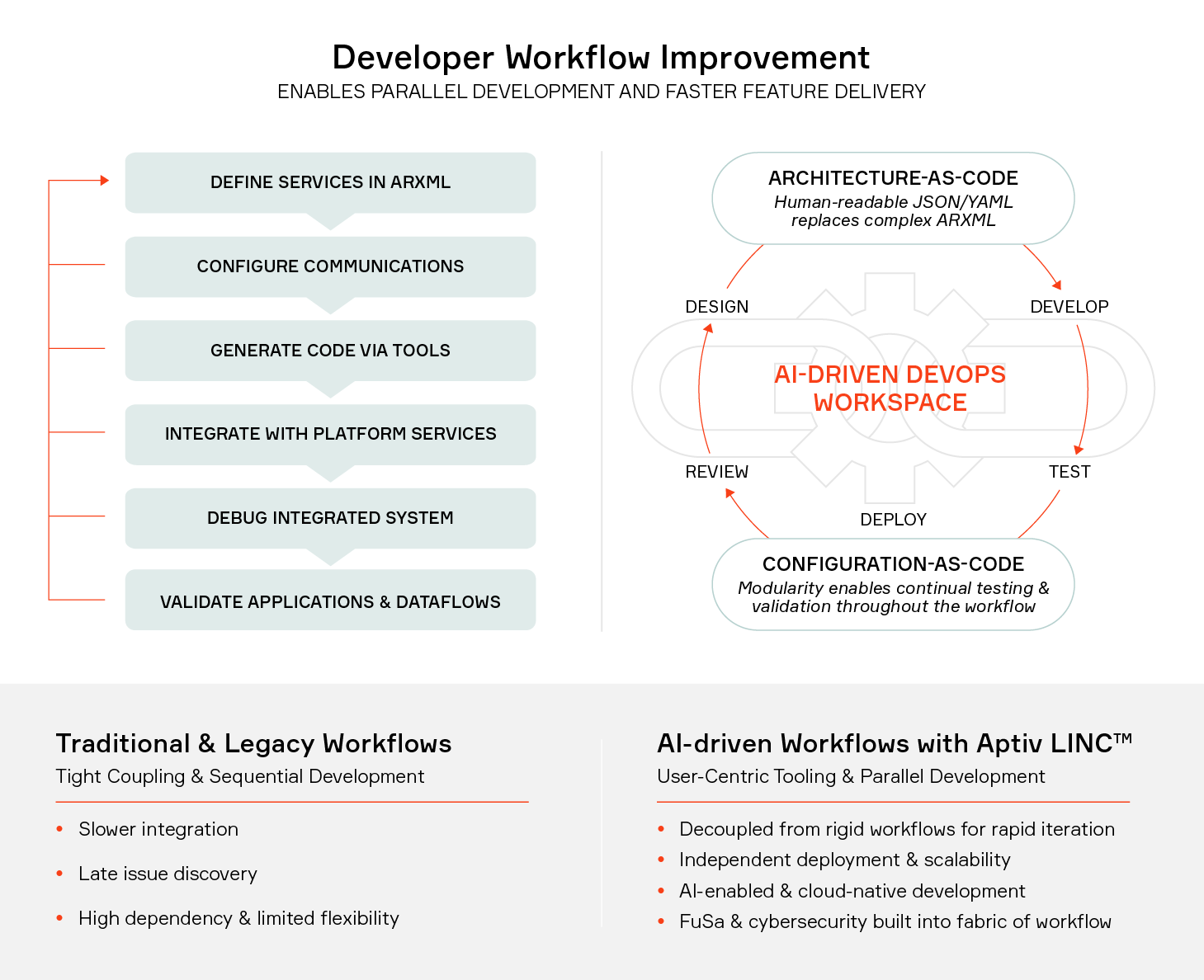
Developers should be able to work with familiar editors, version-control systems and automation tools instead of having to rely on specialized desktop interfaces or scarce tool licenses. Configuration-as-code and human-readable formats such as JSON and YAML make changes easier to review, merge and automate. They also shorten onboarding by allowing engineers to understand system intent without first mastering a proprietary workflow.
Parallel, Independent Workflows
Automotive programs involve teams distributed across domains, suppliers and geographies. A modern platform should let those teams build and test components independently and then integrate changes through controlled, repeatable pipelines. Clear interfaces and modular designs reduce handoffs, avoid the creation of centralized bottlenecks and preserve time for iteration.
A Modular Architecture With Stable Interfaces
Applications, communications services and platform functions should be separable and connected through stable, well-defined APIs. That separation allows teams to improve internal implementations without forcing widespread changes elsewhere. It also supports software reuse across domains, vehicle lines and generations while giving OEMs room to differentiate where it matters.
Portability Across Hardware, Applications and Operating Systems
Changing hardware should not mean rewriting software. A platform should separate application logic from hardware-specific implementation details, reducing the amount of platform-specific code that developers need to maintain and making applications easier to migrate, reuse and support over time. A common runtime environment that enabled binary portability across supported platforms — across microcontroller units and microprocessor units — would represent an extension of this principle. Rather than creating a new build for every hardware target, developers could use the same compiled application binary across multiple hardware and operating system environments, reducing integration effort and accelerating deployment across vehicle programs.
Integrated DevSecOps and Lifecycle Management
Development does not end when code compiles. Automotive platforms should support automated builds, continuous testing, deployment, observability and controlled over-the-air updates. Containerized applications can provide consistent environments from development through deployment, while isolation, incremental updates and reliable rollback make lifecycle operations safer and easier to manage.
Safety, Security and Determinism by Design
Developer velocity cannot come at the expense of vehicle integrity. The platform should help teams build functional safety, cybersecurity, freedom from interference, and deterministic execution into the architecture and workflow. These capabilities should be available as part of everyday development, not added only at the end of a program.
Evaluating the Platform as a Whole
No single attribute is enough. Portability without lifecycle management shifts effort downstream. Open tooling without stable interfaces can create a different kind of fragmentation. Fast iteration without integrated safety and security creates unacceptable risk. Developers need a coherent foundation that connects these capabilities while leaving teams free to choose the tools and workflows that fit their organization.
Aptiv LINC™ brings these attributes together in a modular, hardware-agnostic software platform. It combines configuration-as-code, communications and platform middleware, containerized deployment, lifecycle management, analytics and AI-ready infrastructure. Developers can work in familiar formats, contribute in parallel and separate application logic from hardware-specific implementation while maintaining the safety, security and execution controls automotive systems require.
The practical value is less time spent on integration and platform-specific complexity and more time building features. In one example, LINC reduced a manufacturer’s expected architecture-migration time by nearly two-thirds, demonstrating how a developer-centered platform can translate architectural improvements into measurable program results.